

For much of the 20th century, intelligence appeared to be on a steady rise. Each generation consistently scored higher on IQ tests than the one before it, a trend known as the Flynn Effect.
Better nutrition, improved education, smaller families, and greater exposure to complex ideas were credited for this upward climb. It became almost common sense to assume that future generations would always be sharper, faster, and more cognitively advanced.
That assumption is now being challenged. Across several developed countries, researchers have observed a slowdown and, in some cases, a reversal of this long-standing trend.
Known as the Reverse Flynn Effect, this shift suggests that younger generations, including Gen Z, are scoring slightly lower on certain cognitive tests than their predecessors. While the changes are modest, they raise important questions about how modern life is reshaping the way people think, learn, and process information.
What Is the Reverse Flynn Effect?
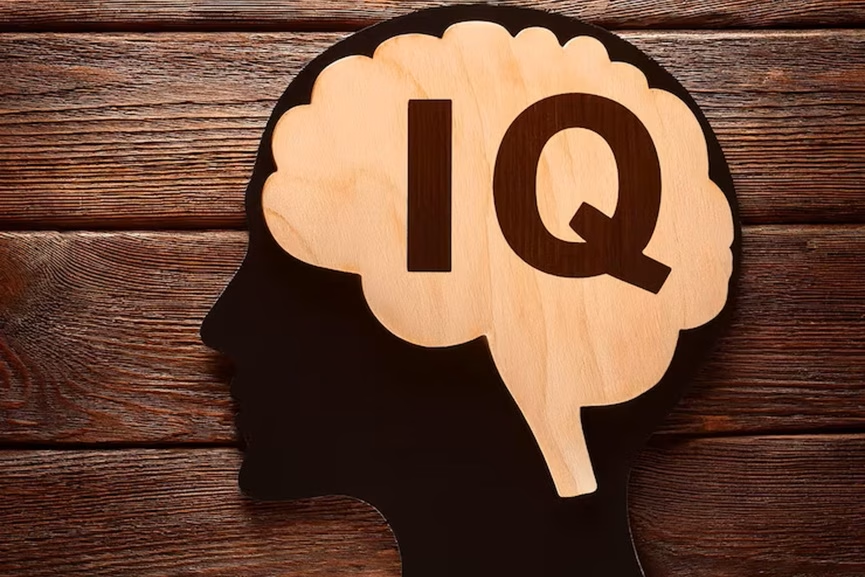
The Reverse Flynn Effect refers to declining performance on standardised intelligence tests over time. Studies in parts of Europe, Australia, and North America have found small but consistent drops in areas such as verbal reasoning, numerical skills, and problem-solving speed.
This does not mean that Gen Z is less intelligent. Intelligence is not a single, fixed trait. What appears to be changing is the type of cognitive skills being measured and valued, and how well traditional tests capture the strengths of today’s youth.
The Digital World and Shaping Minds
One of the most discussed factors behind the Reverse Flynn Effect is the digital environment. Gen Z has grown up with smartphones, social media, and instant access to information. Unlike earlier generations, memorisation and deep recall are less necessary when answers are a few taps away.
This constant connectivity has reshaped attention patterns. Short-form content, rapid scrolling, and algorithm-driven feeds encourage quick consumption rather than sustained focus. While this may weaken performance on traditional tests that reward concentration and long-form reasoning, it also builds other skills, such as rapid information filtering, visual literacy, and multitasking.
In many ways, Gen Z is not thinking less, but thinking differently.

Education, Reading, and Changing Habits
Another key factor is the transformation of education and reading habits. Long hours spent reading books, newspapers, and dense academic texts have declined. In their place are videos, podcasts, interactive content, and summaries. Vocabulary growth and abstract reasoning, both closely linked to reading, may develop more slowly as a result.
At the same time, school systems are under pressure, with larger classrooms, standardised testing, and reduced emphasis on critical thinking in some regions. When combined with digital distraction, these factors may contribute to weaker performance in areas traditionally associated with IQ.
Stress, Sleep, and Mental Health
Modern life also places heavier psychological demands on young people. Gen Z reports higher levels of anxiety, sleep deprivation, and social pressure than previous generations. Chronic stress and lack of sleep are known to impair memory, focus, and problem-solving abilities.
Cognitive potential does not disappear under these conditions, but it becomes harder to access and demonstrate, especially in testing environments.

What This Means for the Future
The Reverse Flynn Effect does not signal intellectual decline. Instead, it highlights a mismatch between old measurement tools and new cognitive realities. Future generations may excel in creativity, adaptability, emotional intelligence, and technological fluency, skills that traditional IQ tests struggle to measure.
Rather than asking whether Gen Z is less intelligent, a better question may be whether society is still using the right yardsticks to understand intelligence at all.
As the world becomes more complex, success will depend less on raw test scores and more on the ability to learn continuously, think flexibly, and navigate uncertainty. If education systems adapt to nurture these strengths, the story of human intelligence may not be one of decline, but of evolution.