
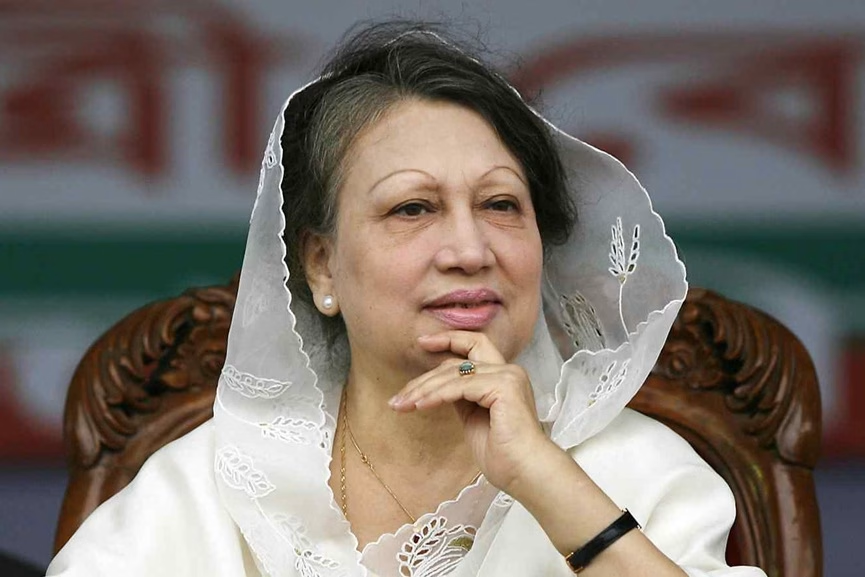
Bangladesh: Khaleda Zia, Bangladesh’s first female prime minister and one of the most influential figures in the country’s modern political history, has died at the age of 79 after a prolonged illness. The Bangladesh Nationalist Party (BNP) said Khaleda passed away at 6 am local time in Dhaka. The country has announced three days of state mourning in her honour.
Khaleda died at Evercare Hospital in the capital, where she had been receiving treatment since November 23. Doctors said she was suffering from multiple serious health conditions, including advanced liver cirrhosis, diabetes, arthritis, and heart and chest complications. She had also recently developed a lung infection.
Her funeral will be held on Wednesday. Funeral prayers are scheduled to take place in front of parliament after midday prayers, after which she will be buried beside her late husband, former President Ziaur Rahman, who was assassinated in 1981.
The BNP Chairperson and former Prime Minister, Begum Khaleda Zia, passed away today at 6:00 a.m., shortly after the Fajr prayer. Inna lillahi wa inna ilayhi raji‘un. We pray for the forgiveness of her soul and request everyone to offer prayers for her departed soul. pic.twitter.com/KY2948UPD5
— Bangladesh Nationalist Party-BNP (@bdbnp78) December 30, 2025
Khaleda’s death marks the end of a political era defined by intense rivalry, deep divisions, and decades of dominance by two women who shaped Bangladesh’s national life. Alongside Sheikh Hasina, her longtime rival, Khaleda, stood at the centre of the country’s politics for more than 30 years. Their bitter contest earned them the nickname the battling begums.
Bangladesh’s interim leader Muhammad Yunus expressed deep sorrow at her passing, calling her a symbol of the democratic movement and saying the nation had lost a guardian at a deeply emotional moment. He appealed for calm and discipline as people observe the mourning period.
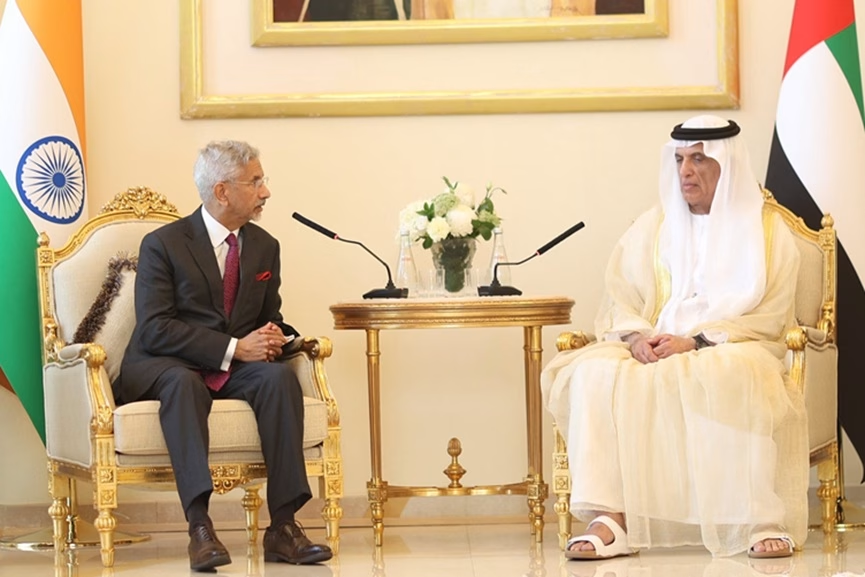
Leaders from the region also paid tribute. Indian Prime Minister Narendra Modi said Khaleda’s contributions to Bangladesh’s development and to relations with India would be remembered. Pakistani Prime Minister Shehbaz Sharif described her as a committed friend of Pakistan and said her lifelong service left a lasting legacy.
Deeply saddened to learn about the passing away of former Prime Minister and BNP Chairperson Begum Khaleda Zia in Dhaka.
Our sincerest condolences to her family and all the people of Bangladesh. May the Almighty grant her family the fortitude to bear this tragic loss.
As the… pic.twitter.com/BLg6K52vak
— Narendra Modi (@narendramodi) December 30, 2025
Outside the hospital where she died, thousands gathered to pay their respects. While her illness had been widely known, many Bangladeshis were still stunned by the loss of a leader who had remained a powerful presence even after years of imprisonment and declining health.
Khaleda Zia’s legacy remains deeply contested, much like that of Sheikh Hasina. Both women rose as champions of democracy during periods of military rule, yet critics also accused both of deepening political polarisation. Khaleda was admired for her defiance of authoritarianism, but her uncompromising approach in opposition and repeated corruption allegations during her time in office divided public opinion.
Born on August 15, 1946, in Dinajpur, then part of East Bengal, Khaleda married army officer Ziaur Rahman at a young age. Rahman emerged as a national figure after the 1971 independence war and later became president, founding the BNP in 1978.
My mother, BNP Chairperson Begum Khaleda Zia, has responded to the call of Almighty Allah and left us today. Inna lillahi wa inna ilayhi raji’un (Indeed, we belong to Allah, and to Him we shall return).
To many, she was the leader of the nation, an uncompromising leader, the… pic.twitter.com/bLsEtzYWgi
— Tarique Rahman (@trahmanbnp) December 30, 2025
Her entry into politics came after a tragedy. Following her husband’s assassination during a failed military coup in 1981, Khaleda inherited leadership of the BNP. Initially underestimated, she proved a formidable political force, leading protests against military ruler Hussain Muhammad Ershad and later joining hands with Sheikh Hasina to bring an end to military rule in 1990.
In 1991, Khaleda led the BNP to victory in what was widely seen as Bangladesh’s first free and fair election. She became only the second woman to head a democratic government in a Muslim-majority country, after Pakistan’s Benazir Bhutto.
During her tenure, she restored the parliamentary system, encouraged foreign investment, and introduced free and compulsory primary education. Though she lost power in 1996, she returned with a landslide victory in 2001.
Her rivalry with Hasina, however, plunged the country into repeated political crises, including the 2007 emergency that brought military-backed rule and led to the detention of both leaders.
Sheikh Hasina expresses condolences on the passing of Begum Khaleda Zia
–I extend my deepest condolences on the passing of BNP Chairperson and former Prime Minister Begum Khaleda Zia.
As the first woman Prime Minister of Bangladesh, and for her role in the struggle to… pic.twitter.com/gqvSEzzVlS
— Bangladesh Awami League (@albd1971) December 30, 2025
Khaleda was jailed again in 2018 on corruption charges that she and her supporters said were politically motivated. Her health deteriorated in custody, and she was later placed under house arrest. She was freed after Hasina was forced from power in 2024, and earlier this year, the Supreme Court acquitted her and her son, Tarique Rahman, in the case.
Despite years of illness, Khaleda had pledged to campaign for the upcoming February elections. Her son, who returned from exile last week, will now lead the BNP into the vote and is expected to be the party’s prime ministerial candidate if it wins.
To her supporters, Khaleda Zia was more than a political leader. To her family, she was a mother who endured imprisonment, persecution, and failing health while remaining committed to her beliefs.