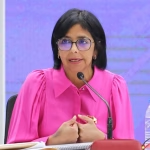

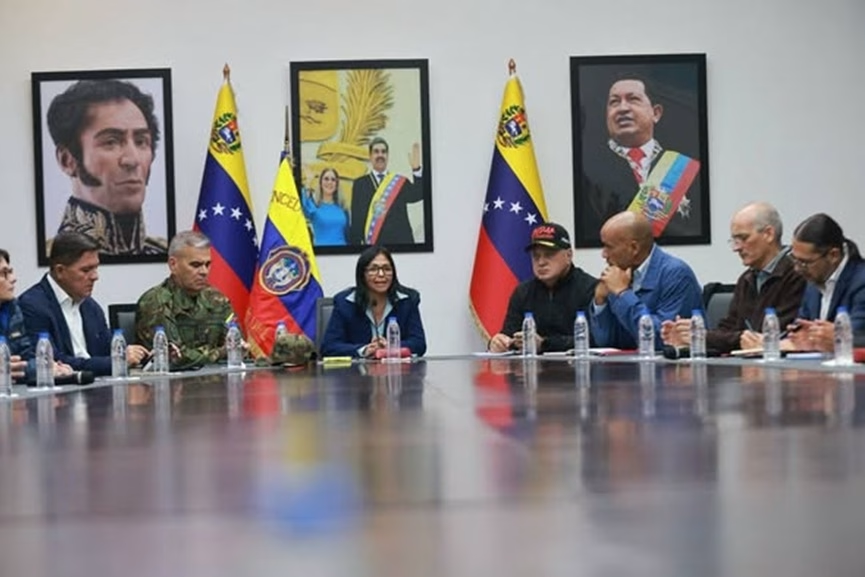
Venezuela: Venezuela’s acting president Delcy Rodriguez struck a conciliatory note, offering to work with the United States on an agenda of shared development, marking the first softening of tone since US forces captured President Nicolas Maduro.
In a statement posted on social media, Delcy Rodriguez said her government was seeking a reset in relations with Washington, after previously condemning Saturday’s raid as an illegal seizure aimed at Venezuela’s national resources. She said Caracas wanted respectful engagement grounded in international law and regional stability.
Rodriguez, who also serves as oil minister, has long been viewed as the most pragmatic figure in Maduro’s inner circle. President Donald Trump has said she is open to cooperation with Washington, even as Venezuelan officials publicly continue to denounce the detention of Maduro and his wife, Cilia Flores, as a kidnapping and insist Maduro remains the country’s legitimate leader.
Trump said that he could authorize further military action if Venezuela does not cooperate with US demands to open its oil industry and curb drug trafficking. He also warned of possible action involving Colombia and Mexico and suggested Cuba’s communist government was nearing collapse. The Colombian and Mexican embassies in Washington did not immediately respond to requests for comment.
Maduro to Appear in US Court
Rodriguez’s statement came a day before Maduro is due to appear before a federal judge in New York on Monday. The Trump administration has framed his capture as a law enforcement operation tied to criminal charges first filed in 2020, accusing him of conspiring with major drug trafficking groups.
Trump has said the decision to seize Maduro was driven not only by those charges but also by the surge in Venezuelan migrants to the United States and Venezuela’s past nationalization of US oil assets. He said American oil companies would return to Venezuela and invest billions to revive its petroleum industry. Global oil prices edged higher in volatile trading as investors weighed the risks of US military action in Venezuela, while Asian stock markets rose.
Maduro, 63, is accused by US prosecutors of supporting groups including the Sinaloa Cartel and the Tren de Aragua gang, directing cocaine trafficking routes and using state institutions to facilitate drug shipments.
The charges were updated on Saturday to include Flores, who was also captured and is accused of ordering kidnappings and killings. Both deny wrongdoing, and a trial is not expected for several months.
Criticism and Legal Questions
The United States has rejected Maduro’s legitimacy since his disputed 2018 re-election, which was widely criticised for irregularities. Trump has dismissed opposition leader Maria Corina Machado as a potential successor, despite her international profile, while Machado maintains that her ally Edmundo Gonzalez won the 2024 vote.
The raid has drawn international criticism, with several countries questioning the legality of detaining a sitting head of state. The UN Security Council is set to meet on Monday to discuss the operation, which Secretary-General Antonio Guterres has warned could set a dangerous precedent. China again criticised Washington, calling for Maduro and Flores to be released.
The action has also sparked debate in Washington, where opposition Democrats say they were not fully briefed on the administration’s Venezuela strategy. Secretary of State Marco Rubio is scheduled to brief senior lawmakers later on Monday.
Once among Latin America’s wealthiest nations, Venezuela has suffered a prolonged economic collapse over the past two decades, prompting the departure of roughly one in five citizens abroad. The removal of Maduro, who ruled for more than 12 years after the death of Hugo Chavez, risks deepening instability in the country of 28 million.