
Washington: A quarter of developing countries are poorer today than they were before the Covid-19 pandemic, highlighting a deep and uneven global recovery, the World Bank has warned.
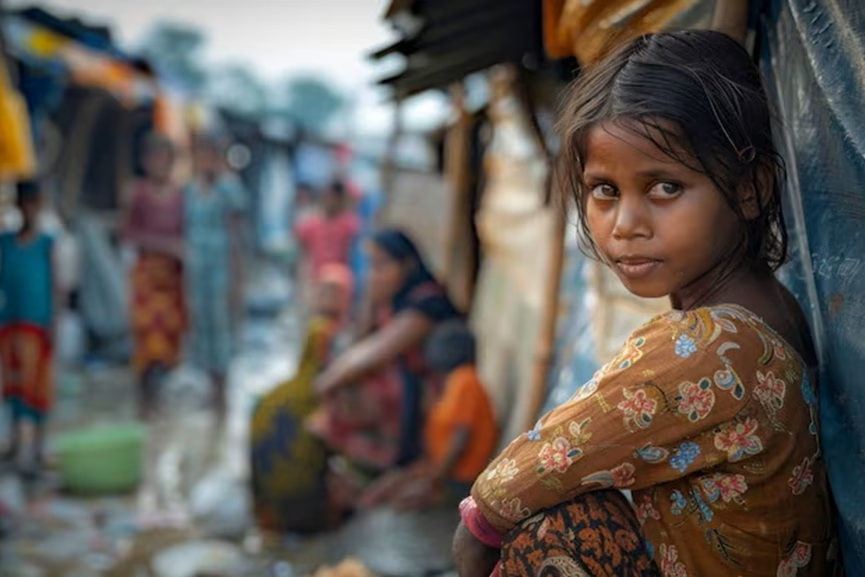
A new assessment by the World Bank reveals that many low-income economies, particularly in sub-Saharan Africa, have suffered lasting economic damage over the six years to the end of last year. Wars, food shortages, and weak policy responses have slowed their rebound, leaving average incomes below 2019 levels in one out of every four developing nations.
The bank said global growth has slowed since the pandemic and is no longer strong enough to cut extreme poverty or generate sufficient jobs where they are most needed. Growth in emerging markets and developing economies is expected to ease from 4.2 percent last year to 4 percent next year.
While the global economy has shown resilience, helped by stronger-than-expected performance in the United States, the bank warned that momentum remains weak. Overall world growth is projected to hold near current levels, slipping from 2.7 percent in 2025 to 2.6 percent in 2026 before edging back to 2.7 percent in 2027. That pace, the bank said, would deliver only modest progress.
The US economy is estimated to have grown by 2.1 percent in 2025 and is forecast to expand by 2.2 percent in 2026, following upgrades to earlier projections. By contrast, the euro area continues to lag, with growth of just 0.9 percent expected in 2025 and 1.2 percent in 2026.
Global growth has been more resilient than expected—but the recovery remains uneven.
The latest Global Economic Prospects finds that about one-quarter of developing economies still have lower per capita GDP than in 2019.
Read the report: https://t.co/iZQbTscovS pic.twitter.com/DF6uon9Jyh
— World Bank (@WorldBank) January 13, 2026
In many poorer countries, recent growth has been too weak to offset earlier economic slumps. The bank said conflict and famine have delayed recovery in several regions, leaving millions vulnerable to prolonged hardship.
World Bank chief economist Indermit Gill said the setbacks were not solely the result of bad luck. He said policy failures had played a significant role and warned that without reform, many countries risk long-term stagnation.
Gill said governments needed to enforce strict budget discipline, encourage private investment and trade, and invest more in education and new technologies. He warned that current growth levels were insufficient to create jobs for the next generation, with around 1.2 billion young people expected to enter the labour market over the coming decade.
The bank also warned that global growth over the next few years is likely to be slower than during the troubled 1990s, even as public and private debt remain at record highs.