
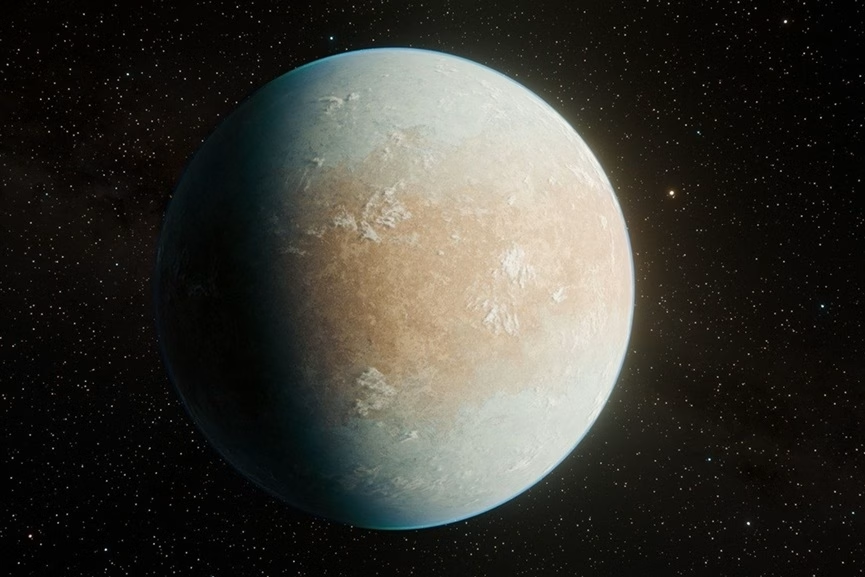
US: Astronomers have identified a promising new Earth-sized planet located about 146 light-years from our solar system, raising fresh interest in the search for potentially habitable worlds beyond Earth.
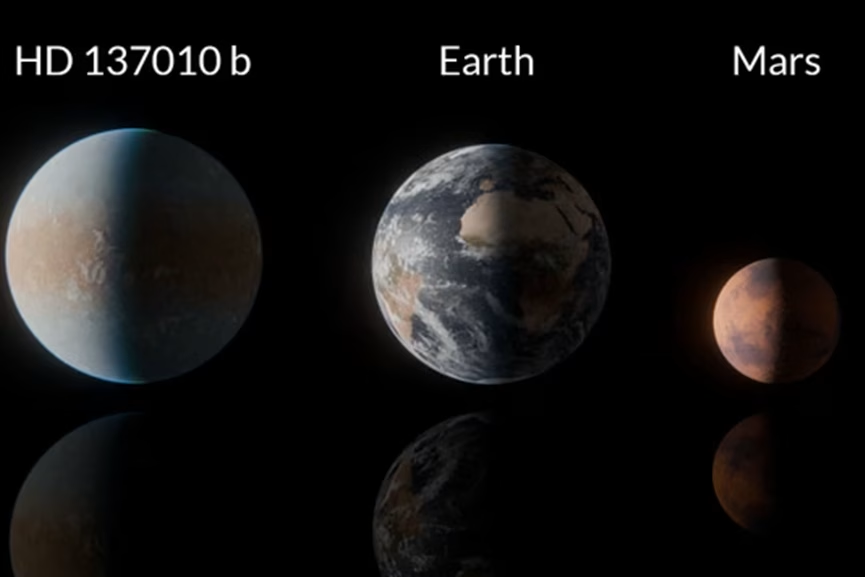
The candidate planet, known as HD 137010 b, orbits a sun-like star and is estimated to be around six percent larger than Earth. Scientists believe it has roughly a fifty percent chance of lying within the habitable zone of its star, the region where conditions could allow liquid water to exist on the surface.
The discovery was made by an international team of researchers from Australia, the United Kingdom, the United States, and Denmark. They analysed data collected in 2017 by the NASA Kepler space telescope during its extended K2 mission.
Earth-Like Orbit, Mars-Like Conditions
HD 137010 b follows an orbit that closely resembles Earth’s, completing one revolution around its star in about 355 days. However, the star it orbits is slightly cooler and dimmer than our sun. As a result, scientists estimate that the planet’s surface temperature may be closer to that of Mars and could drop below- 70 degrees Celsius.
Despite the cold conditions, the planet’s size, orbit, and relative proximity make it one of the most intriguing Earth-sized candidates discovered in recent years.
The planet was detected using the transit method, which measures tiny dips in a star’s brightness when a planet passes in front of it. The faint signal was first noticed by citizen scientists taking part in the Planet Hunters project.
One of those volunteers was Alexander Venner, who spotted the signal while he was still in high school. He later went on to pursue a career in astronomy and completed a PhD at the University of Southern Queensland, where much of the follow-up work was carried out.
Researchers initially approached the finding with caution, given the weakness of the signal. The data was checked multiple times to rule out errors or false positives. Further analysis confirmed that the dimming event matched what scientists would expect from a planet transit.
Target for Future Telescopes
The relative brightness and closeness of the host star make HD 137010 b a strong candidate for future observation. Scientists say it could be among the first Earth-sized planets in a habitable zone to be studied in detail by next-generation telescopes.
Independent experts have welcomed the discovery but note that more observations are needed before the planet can be formally confirmed. So far, only one transit has been detected, while standard practice usually requires at least three.
There is also uncertainty about the planet’s true nature. While it could be rocky and Earth-like, it may also be a large icy world, sometimes described as a super snowball, with much of its water locked beneath frozen surfaces. Even so, astronomers stress that HD 137010 b stands out as one of the most accessible candidates for future study.