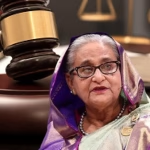

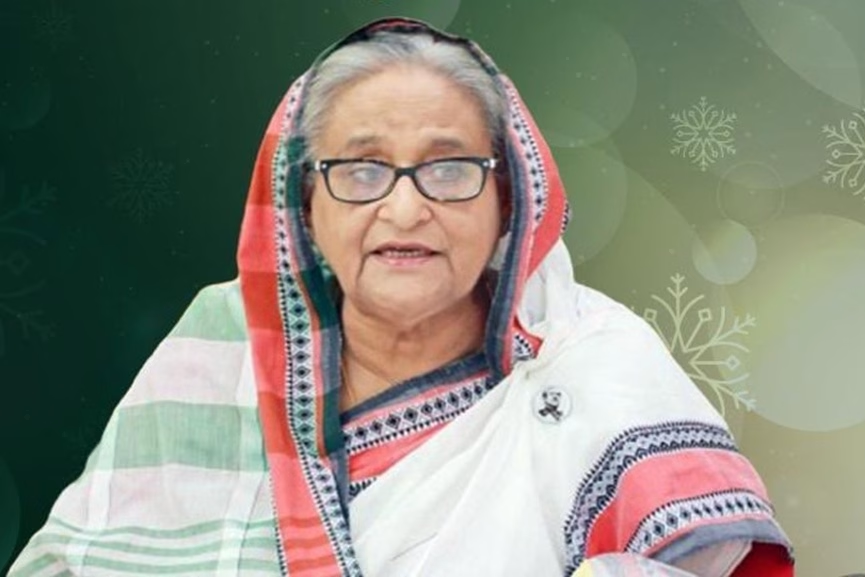
Dhaka: Bangladesh’s ousted Prime Minister Sheikh Hasina has sharply criticised the country’s upcoming election from her exile in India, warning that banning her party from the polls risks pushing the nation into deeper political instability.
Hasina, whose Awami League has been barred from contesting the February 12 election, said the move had effectively stripped millions of citizens of their right to political participation. She argued that elections held without broad inclusion cannot be free, fair, or credible, and would only fuel resentment and weaken state institutions.
The former leader was removed from power last year after a massive student-led uprising that turned violent and ended her 15-year rule. Hundreds were killed during the unrest. Following her ouster, she fled to India on August 5, 2024. A Bangladesh court later sentenced her to death in absentia over her government’s handling of the protests, a verdict she has dismissed as politically motivated.
More than 127 million voters are eligible to take part in Bangladesh’s most consequential election in decades. It will be the first national vote since Hasina’s removal and is being overseen by an interim administration led by Nobel Peace Prize laureate Muhammad Yunus.
Alongside the election, voters are expected to weigh a proposed constitutional referendum that could introduce sweeping political reforms. Campaigning began last week, with rallies held in Dhaka and other major cities.
Yunus took office just three days after Hasina fled the country and has pledged to deliver a credible and orderly election. His office says security forces will prevent violence or intimidation and that international observers and human rights groups have been invited to monitor the process. The Election Commission expects around 500 foreign observers, including delegations from the European Union and the Commonwealth.
As the February 2026 election approaches, exclusion, intimidation, and managed outcomes are eroding public trust. When voters lose real choice, and institutions lose neutrality, elections become triggers for unrest, not solutions.
Bangladesh needs credibility, inclusion, and… pic.twitter.com/CbwUWT2Bwj
— Bangladesh Awami League (@albd1971) January 26, 2026
Since Hasina’s fall, Bangladesh has faced increased political tensions. Rights groups and minority organisations accuse the interim authorities of failing to protect civil liberties, while the Awami League alleges arbitrary arrests and deaths in custody of its supporters, claims the government denies.
There are also rising fears over the growing influence of Islamist groups and attacks on minorities, particularly Hindus. Press freedom has become another flashpoint, with journalists facing criminal cases and protests targeting major newspaper offices.
The Bangladesh Nationalist Party, led by Tarique Rahman, has emerged as the main contender in the election. Rahman returned to the country in December after more than 17 years in exile. His principal challenger is a coalition of 11 allied groups led by the Islamist Jamaat-e-Islami, which was heavily suppressed under Hasina’s rule.
Hasina, long accused by critics of running an increasingly authoritarian system, said Bangladesh must move beyond a history of political bans and election boycotts. She acknowledged that past elections under her government suffered from participation gaps but said repeating the same patterns would prevent national reconciliation.
According to her, Bangladesh now needs a legitimate government formed with the genuine consent of the people, arguing that only such a mandate can help the country recover from years of political conflict and violence.