

Caracas: Venezuela’s Congress has approved an overhaul of the country’s oil sector, passing a new hydrocarbons law aimed at opening the industry to greater private and foreign participation after sustained pressure from the United States.
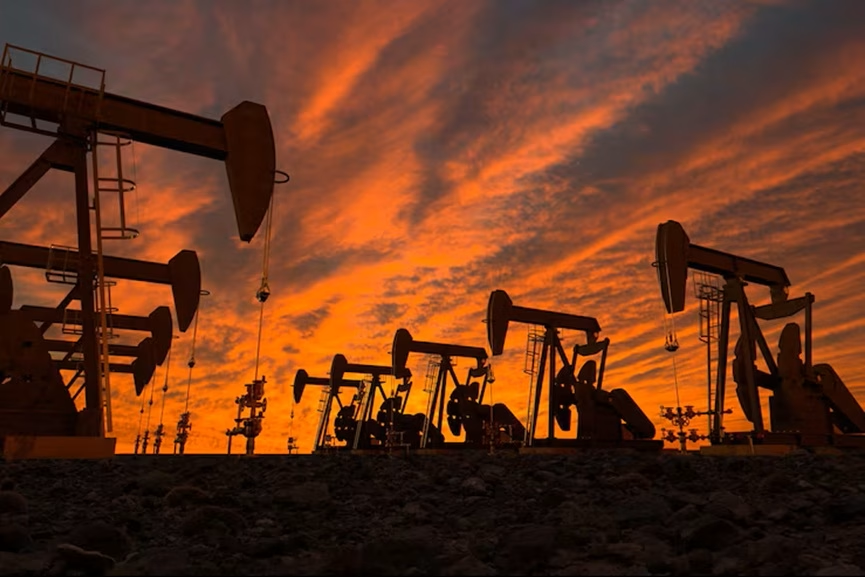
The legislation promises to loosen long-standing state controls by allowing private companies a larger role in oil production and sales, easing tax and royalty burdens, and permitting independent arbitration in disputes. While the state oil company PDVSA retains a central role, the changes mark a notable shift in a sector that has been tightly controlled for decades.
Acting President Delcy Rodríguez, who has given final approval to the bill, described the law as a step toward rebuilding the country’s future and securing prosperity for coming generations. Congressional leader Jorge Rodríguez welcomed the vote, saying it marked the beginning of a recovery after years of hardship.
The law was approved unanimously by the regime-aligned National Assembly following a fast-tracked public consultation process. It allows private firms, even as minority partners in joint ventures with PDVSA, to directly manage technical and operational aspects of projects. It also opens the door to cutting royalty payments, which currently stand at 30 percent, potentially down to zero.
The vote comes amid rapidly evolving ties with Washington. Earlier on Thursday, Rodríguez spoke by phone with US President Donald Trump, who later said the United States was preparing to reopen Venezuelan airspace to commercial flights. Several international airlines had suspended operations after Washington declared the country’s airspace closed as part of its pressure campaign against President Nicolás Maduro.
Trump also said major US oil companies were already assessing sites in Venezuela for possible operations. His administration has eased some sanctions, with the US Treasury issuing a general licence allowing certain transactions with PDVSA.
Venezuela holds the world’s largest proven oil reserves but produces less than one percent of the global supply. Once a leading exporter, its output has collapsed from about 3.4 million barrels a day to roughly 1 million after years of mismanagement, corruption, and the impact of US sanctions.