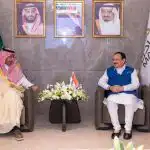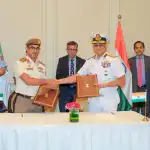

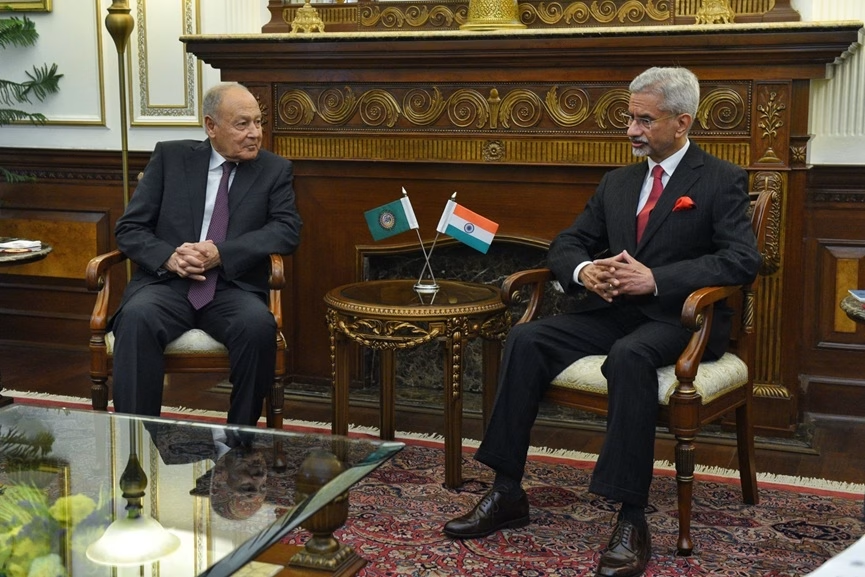
New Delhi: India is set to host a landmark gathering of Arab foreign ministers in New Delhi on 31 January 2026, marking the second India-Arab Foreign Ministers’ Meeting after a decade-long gap.
The event will bring together representatives from all 22 member states of the League of Arab States, along with Secretary General Ahmed Aboul Gheit. Preparatory talks were held a day earlier at the fourth India-Arab Senior Officials’ Meeting at Bharat Mandapam.
External Affairs Minister Dr S. Jaishankar will chair the ministerial meeting, while the visiting dignitaries are scheduled to meet Prime Minister Narendra Modi before the formal proceedings.
The revival of this high-level dialogue underscores the growing strategic partnership between India and the Arab world, built on centuries of trade, cultural exchange, and scholarly interaction across the Arabian Sea.
Formal institutional ties date back to a 2002 Memorandum of Understanding establishing regular dialogue, followed by the creation of the Arab-India Cooperation Forum in 2008, later revised in 2013. India holds observer status at the League of Arab States, with its ambassador in Cairo serving as permanent representative.
The first India-Arab Foreign Ministers’ Meeting took place in Manama, Bahrain, in January 2016, resulting in the adoption of the Manama Declaration and an Executive Programme covering five key areas: economy, education, energy, media, and culture. Biennial ministerial meetings and annual senior officials’ gatherings were agreed upon, though implementation has varied over the years.
Pleased to welcome H.E. Ahmed Aboul Gheit, Secretary General of the League of Arab States, who arrived in New Delhi for the 2nd India-Arab Foreign Ministers’ and related meetings.
High level engagements over the next two days reflect the shared commitment for a stronger… pic.twitter.com/Gfj4KfcCks
— Randhir Jaiswal (@MEAIndia) January 29, 2026
Recent initiatives include the sixth India-Arab Partnership Conference for business leaders in New Delhi in 2023, with the seventh planned on the Arab side. In education, the first India-Arab Universities’ Presidents’ Conference in February 2025 addressed higher education, skill development, AI, quantum computing, biotechnology, and student exchanges, with the second conference scheduled for Ajman in early 2026.
Energy cooperation has expanded through the Arab-India Energy Forum, first held in 2021. Cultural and media exchanges have continued through symposiums and festivals, with more events planned for the coming years.
Bilateral trade exceeds $240 billion, dominated by hydrocarbons. India imports nearly half its crude oil, 60 percent of its LNG, and over 95 percent of its LPG from Arab states. Indian investments extend across energy and infrastructure, while the diaspora of more than nine million Indians contributes significantly to Gulf economies.
The meeting comes amid ongoing regional turbulence, including conflicts in West Asia. The Arab League has expressed solidarity with India following terror attacks, notably condemning the April 2025 Pahalgam incident and welcoming Indian delegations. Discussions at the New Delhi meeting are expected to focus on trade, energy security, education, counter-terrorism, and regional stability, reaffirming India’s role as a trusted partner in an extended neighbourhood.