
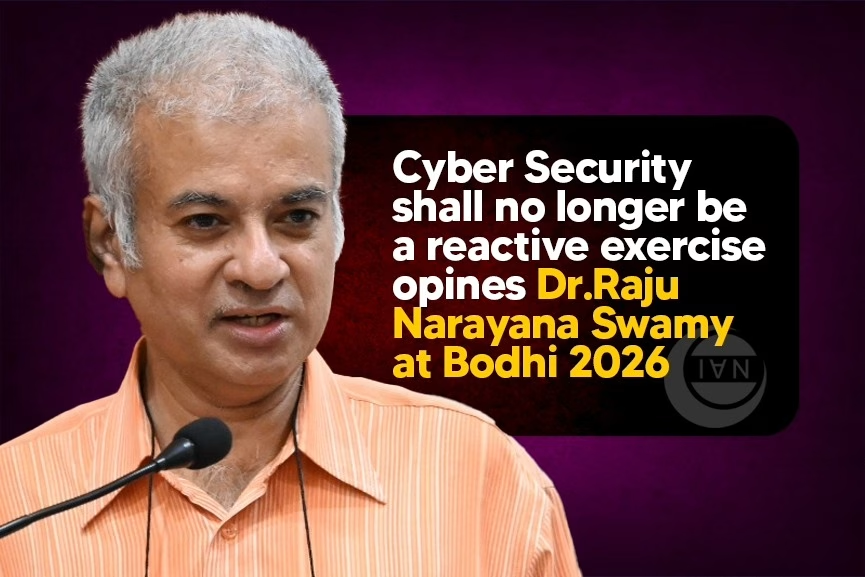
Kochi: Dr. Raju Narayana Swamy, Principal Secretary to the Government of Kerala and widely regarded as the state’s anti-corruption crusader, has called for a fundamental shift in cybersecurity strategy, from reactive defense to proactive resilience, at a time of rapid rise of artificial intelligence.
Raju Narayana Swamy was addressing a gathering at Rajagiri College in Kochi on the theme “Cyber Security in the Age of AI,” in a session presided over by Prof. Fr. Saju.
Dr. Swamy emphasized that the enterprises can no longer rely solely on traditional cybersecurity frameworks. Instead, they must adopt cutting-edge solutions powered by artificial intelligence and machine learning to stay ahead of evolving threats.
He highlighted the emergence of AI-driven self-learning systems as a ‘game changer’ capable of continuously adapting to new threat patterns.
These systems, he noted, are also enabling the development of next-generation firewall technologies that are contextually intelligent.
“Such systems can interpret the context of every piece of inbound and outbound communication within an enterprise network,” Dr. Swamy explained, adding that this ensures stronger protection against unlawful data exchanges while allowing legitimate communications to flow seamlessly.
Three-Pronged Security Strategy
Outlining a roadmap for robust cybersecurity, Dr. Swamy proposed a three-pronged approach:
- Integration of Layered Security: Strengthening traditional Layer 3 (network-level) defenses with Layer 7 (application-level) security solutions.
- Forward-Thinking Frameworks: Adopting a proactive and anticipatory approach to network security.
- Future-Proof Investments: Investing in technologies that address not only current threats but also emerging and long-term challenges.
Quantum Computing: Opportunities and Challenges
The session also delved into the transformative potential of quantum computing. Dr. Swamy referenced predictions by Richard Feynman, who foresaw the advent of nearly invisible, highly powerful computing systems before 2050.
Drawing parallels with the evolution of classical computers, from room-sized machines in the 1960s to compact smartphones, he noted that governments and industries are now investing billions to make quantum computing a practical reality.
However, he underscored key technological challenges, particularly the issue of ‘noise,’ where stray photons interfere with quantum systems, leading to unintended computational errors.
“Quantum computing represents a shift from how humans compute to how the universe computes,” he remarked, describing it as a fusion of quantum physics and computer science.
Concluding his address, Dr. Swamy invoked a thought-provoking line associated with Morpheus while discussing the implications of augmented and virtual reality.
“How do you define real? If you are talking about what you can feel, smell, taste, and see, then real is just electrical signals interpreted by your brain,” he quoted, leaving the audience reflecting on the evolving boundaries between reality and digital experience.