
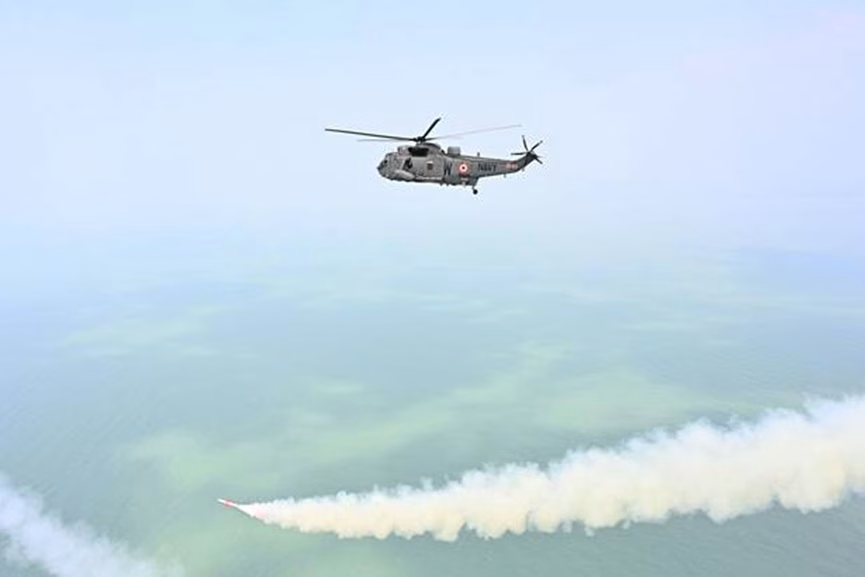
New Delhi: The Indian Defence Research and Development Organisation (DRDO) and the Indian Navy have successfully carried out the first-ever salvo launch of the Naval Anti-Ship Missile–Short Range (NASM-SR) from a helicopter platform over the Bay of Bengal off the coast of Odisha.
During the trial, two missiles were fired in quick succession from the same helicopter. The test marks an important milestone as it demonstrates the system’s ability to engage maritime targets with rapid, back-to-back strikes.
Officials involved in the program said that the successful launch reflects growing confidence in India’s air-launched anti-ship missile capability, developed entirely within the country.
The @DRDO_India & Indian Navy successfully jointly conducted the maiden Salvo launch of Naval Anti-ship Missile-Short Range (NASM-SR) from Indian Navy’s helicopter platform, off the coast of Bay of Bengal in Odisha.
Raksha Mantri Shri @rajnathsingh complimented DRDO, Indian… pic.twitter.com/oPmiyAOZlG
— रक्षा मंत्री कार्यालय/ RMO India (@DefenceMinIndia) April 29, 2026
Advanced hydrodynamic testing
In a parallel development, DRDO and the Indian Navy have completed advanced hydrodynamic performance assessment and model testing for a frontline warship project.
The work was carried out by the Naval Science and Technological Laboratory (NSTL) in collaboration with the Navy’s Warship Design Bureau. The trials covered detailed studies on hull resistance, propulsion efficiency, sea-keeping behavior, and maneuverability.
According to DRDO, the project relied on a combination of computational fluid dynamics (CFD) simulations and physical model testing to validate performance. Officials said the results were found to be in line with international benchmarks in terms of precision and reliability.
The findings and deliverables were formally handed over by DRDO Chairman and Secretary (DDR&D) Samir V. Kamat to Sanjay Sadhu, Controller of Warship Production and Acquisition, in the presence of senior scientists and naval officials.
Naval Science & Technological Laboratory(NSTL), DRDO in collaboration with Warship Design Bureau of Indian Navy has successfully completed Hydrodynamic Performance Assessment and Model Testing of Frontline Indian Naval Ship Project.
Comprehensive capabilities were demonstrated… pic.twitter.com/HDSpJHsZjU
— DRDO (@DRDO_India) April 25, 2026
New armoured platforms unveiled
Earlier in the day, DRDO also showcased two advanced armored platforms, tracked and wheeled, developed by the Vehicles Research & Development Establishment (VRDE).
These platforms are designed to meet evolving battlefield requirements and come integrated with an indigenous 30 mm crewless turret. They also feature a 7.62 mm PKT machine gun and are capable of launching anti-tank guided missiles.
The platforms offer enhanced mobility, protection, and firepower, supported by a high-power engine and automatic transmission. They are designed with STANAG Level 4 and 5 protection standards, along with modular blast and ballistic shielding.
The vehicles also include amphibious capability using hydro jet systems, allowing them to cross water obstacles with greater ease.
The Ministry of Defense noted that the indigenous content in these systems currently stands at around 65 percent, with plans to increase it to 90 percent in the coming phase of development.