
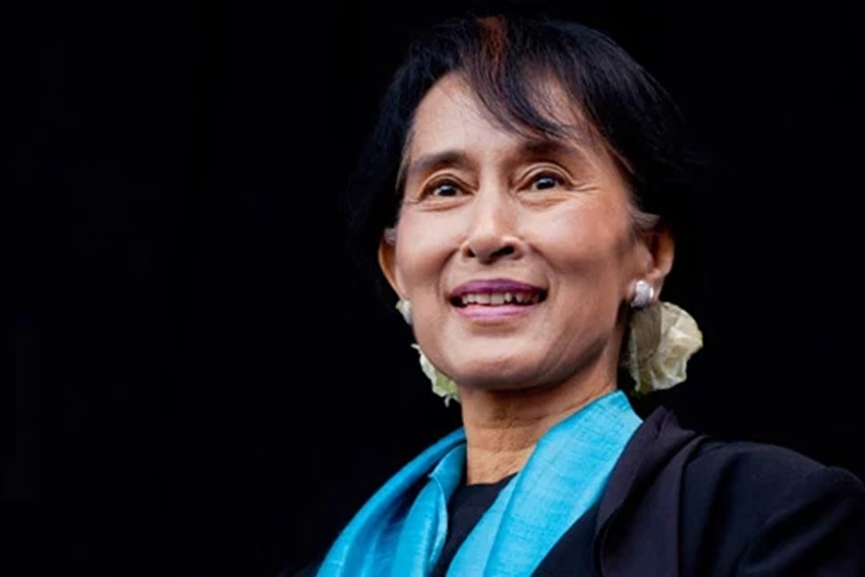
Naypyidaw: Myanmar’s former leader Aung San Suu Kyi has been transferred from prison to house arrest in the capital, Naypyidaw, more than five years after the military coup that removed her government from power.
The move, confirmed by her legal team, marks a notable change in her detention, though questions remain about her condition and the broader political climate.
State broadcaster MRTV reported that the remainder of Suu Kyi’s sentence would now be served at a ‘designated residence,’ without disclosing the location.
Family Seeks Proof of Life
Despite the development, Suu Kyi’s son, Kim Aris, expressed deep concern over her well-being. He described his mother as ‘cut off from the world’ and called for proof that she is alive, along with the ability to communicate with her directly.
Kim Aris’s remarks reflect ongoing uncertainty surrounding her health and treatment since her detention in 2021.
A photograph aired on military-controlled television showed Suu Kyi seated beside two uniformed officers. However, Aris dismissed the image as outdated, saying it was taken years ago and offered little reassurance about her current state.
At the United Nations, spokesperson Stephane Dujarric described the shift to house arrest as a way to help create conditions for a credible political process. Dujarric reiterated calls for an immediate end to violence and genuine dialogue among all parties in Myanmar.
However, rights groups and campaigners remain unconvinced. Advocacy organizations accused the military leadership of using Suu Kyi’s case to ease international pressure while continuing its crackdown on civilians. Reports of ongoing airstrikes and attacks on civilian infrastructure have reinforced concerns that little has changed on the ground.
Suu Kyi’s sentence has also been reduced as part of a broader prisoner amnesty linked to a Buddhist holiday. Originally handed a total of 33 years on charges widely seen as politically motivated, her sentence was later cut to 27 years and has now been reduced further to 18 years. Even with the reduction, she still faces more than a decade in detention.
Legal representatives said she has endured harsh conditions during her imprisonment, describing her experience as deeply distressing. While welcoming the move to house arrest, they stressed that she remains unjustly detained.
The transfer comes amid continued instability in Myanmar. Fighting between the military and resistance forces has intensified, with hundreds reportedly killed in recent months. The situation has drawn international criticism, particularly after elections widely dismissed as lacking credibility.
Military leader Min Aung Hlaing, who led the 2021 coup and now serves as president, has faced sustained calls to release political prisoners and engage in dialogue.
Once a global icon of democracy and resistance, Suu Kyi spent years under house arrest during a previous military regime before leading Myanmar’s civilian government.