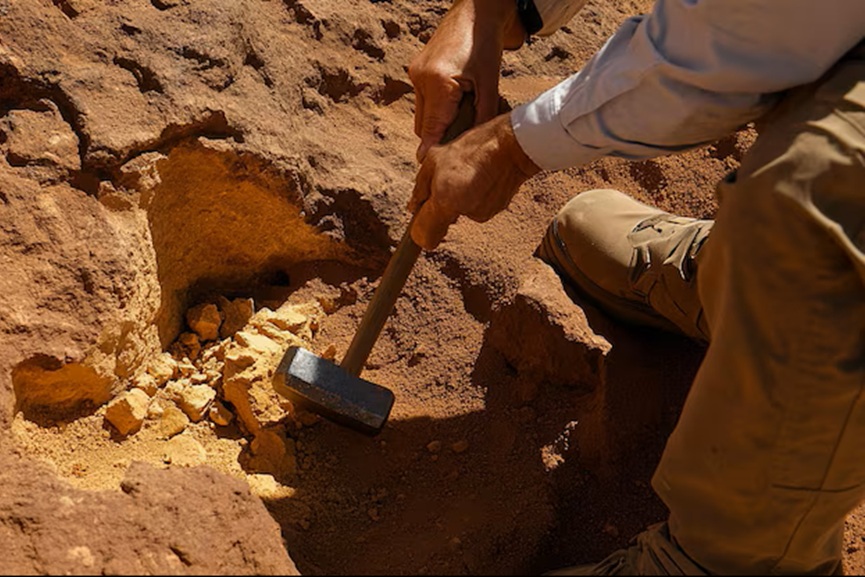
Soppeng, Indonesia: Archaeologists from Australia and Indonesia have uncovered stone tools on Sulawesi island that may represent the earliest evidence of humans living in the Wallacea region, dating back approximately 1.5 million years.
The findings, published in the journal Nature, could reshape our understanding of early human migration across islands between Asia and Australia.
The small, chipped tools used to cut small animals and carve rocks were found beneath the soil in the Soppeng region of South Sulawesi. Using radioactive dating methods on the tools and animal teeth found nearby, researchers established an age of up to 1.48 million years.
Significance of the Discovery
Previously, the earliest evidence of humans in Wallacea, an archipelago comprising Sulawesi, Lombok, Flores, Timor, and other islands, was thought to be approximately 1.02 million years old, with limited finds on Flores Island in Indonesia and Luzon Island in the Philippines. This timeline was based on the assumption that early humans, specifically Homo erectus, were incapable of long-distance sea travel.
Stone tools over 1 million years old have been found in Sulawesi by Adam Brumm’s team. This discovery challenges our understanding of human migration in Asia and may reveal ancient island routes. #Archaeology #HumanOrigins #WorldTechnology #SulawesiDiscovery #AdamBrumm pic.twitter.com/jY8iIlv7Tc
— World Technology Games (@WTechGames) August 10, 2025
Adam Brumm, lead archaeologist from Griffith University in Queensland, Australia, emphasized that, “These were artefacts made by ancient humans who lived on the earth long before the evolution of our species, Homo sapiens.” He added that, “We think Homo erectus somehow crossed a significant ocean gap from the Asian mainland to Sulawesi at least 1 million years ago.”
Wallacea is a biogeographical region in Eastern Indonesia, comprising islands situated between Borneo and Java to the west and Australia and New Guinea to the east. The area is named after naturalist Alfred Russel Wallace, who famously studied its unique flora and fauna.
The new evidence of human presence this far back in Wallacea suggests that early humans were more adept at maritime travel than previously believed, challenging existing models of prehistoric migration and adaptation in Southeast Asia.
The discovery opens new avenues for understanding the routes and capabilities of early human populations in the region, offering fresh insights into the complex history of human dispersal across islands and continents.