
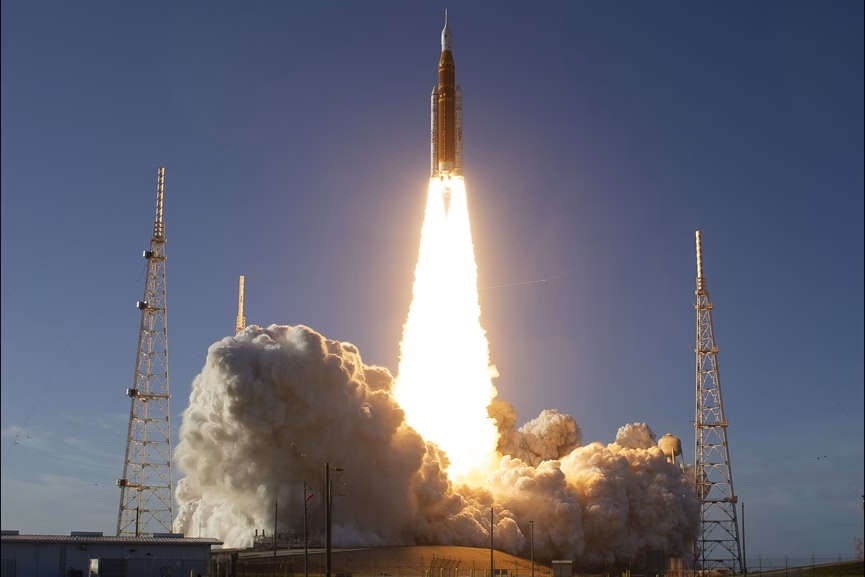
Florida: NASA astronauts on board the Artemis II mission have successfully embarked on their journey to the moon after a crucial engine burn that propelled the spacecraft out of Earth’s orbit.
The crucial engine burn, referred to as a translunar injection, was a defining moment for the mission. With this precise engine burn, the Orion spacecraft transitioned from an orbit around the Earth to a trajectory that will take the astronauts further into lunar space than ever before.
A Turning Point in Spaceflight
The engine burn was an ‘exit ramp’ for the spacecraft, leveraging the gravity of the Earth to propel the spacecraft towards the moon. At this point, the mission will largely depend on the laws of physics.
The astronauts are expected to enter the moon’s gravitational sphere by the end of the weekend if everything goes as planned. At its farthest point, the mission is expected to beat the record set by Apollo 13 back in 1970.
Commander Reid Wiseman has described the view from tens of thousands of miles away as stunning and surreal, commenting on how the Earth is now a shrinking, glowing orb. He has said that taking pictures has been a bit tricky, comparing it to taking a picture of the moon from a backyard on Earth.
Next stop: lunar flyby.
The Orion spacecraft recently ignited its main engine on the service module for about six minutes to provide about 6,000 pounds of thrust. This maneuver not only sets the Artemis II astronauts on the path to the Moon. It also puts the crew in a free… pic.twitter.com/cWTfpzGC7d
— NASA (@NASA) April 3, 2026
Life Onboard: Small glitches, Big moments
The astronauts have spent their first day in space adapting to life on board the Orion. The crew has been testing out all the systems, from their navigation tools to their cameras. While most systems have been working well, there have been a few small problems for the crew.
A problem arose when they were trying to gain access to their email, but this has been resolved. A bigger issue arose when a warning light went off on their toilet system.
Despite the cramped quarters of the spacecraft, it is well-furnished with modern comforts. The waste disposal system of the spacecraft is more advanced compared to previous missions. It recycles liquid waste and stores solid waste.
The crew of Artemis II is recording its mission with a combination of professional and personal equipment, including GoPro cameras, iPhones, and high-end Nikon cameras. The choice of iPhones for recording the mission is a sign of a shift towards more accessible and real-time storytelling of events.
Although NASA has not released any images of the mission, it is expected to do so during the course of the mission. Some of the most-awaited events include a new version of the famous ‘Earth Rise’ photo taken by William Anders of the Apollo 8 mission. By the sixth day of the mission, the astronauts will be at a distance of 252,000 miles from Earth.