
Sydney: Australia began a period of national mourning on Monday after the country’s deadliest mass shooting in nearly three decades left 16 people dead at a Jewish celebration on Sydney’s iconic Bondi Beach, prompting renewed scrutiny of the nation’s gun laws.
The attack unfolded on Sunday evening during a Hanukkah event attended by around 1,000 people. A father and son opened fire, killing 15 people, before the older man, aged 50, was shot dead by police at the scene. His 24-year-old son remains in critical condition in the hospital. Police said 40 people were taken to the hospital, including two officers who are in serious but stable condition. Victims ranged in age from 10 to 87.
Authorities confirmed only two attackers were involved, ending earlier concerns about a possible third suspect. Police did not officially name the gunmen, but Australian media identified them as Sajid Akram and his son Naveed Akram. Officials said the father had held a firearms licence since 2015 and legally owned six registered weapons. One of the men had previously come to the attention of authorities but was not considered an immediate threat.
Tonight and over the coming days, we are holding the Jewish community close.
For the 8 nights of Chanukah, Jewish families around the world fill their windows with light – something that has been passed down through generations.
Tonight, I am lighting a candle in solidarity… pic.twitter.com/gYjyGPpq7R
— Anthony Albanese (@AlboMP) December 15, 2025
Videos from the scene appeared to show the attackers using a bolt-action rifle and a shotgun. Police said they were still investigating how the weapons were obtained and whether warning signs had been missed. Two Islamic State flags were found inside the attackers’ vehicle, according to reports by Australia’s national broadcaster, raising further questions about radicalisation and domestic security.
The shooting has reignited debate over whether Australia’s already strict gun laws remain adequate. Prime Minister Anthony Albanese said the government would consider limits on the number of firearms permitted under a single licence and review how long licences should remain valid.
The violence was brought to an end in part by the actions of a bystander who tackled and disarmed one of the attackers before being shot. The man, identified by local media as Ahmed al Ahmed, a 43-year-old fruit shop owner, underwent surgery after being shot twice. A fundraising campaign for him raised more than A$550,000 within a day.
Witnesses described scenes of chaos as gunfire echoed across the crowded beach. People fled along the sand and into nearby streets, leaving behind shoes, phones, and bags as they scrambled for safety.
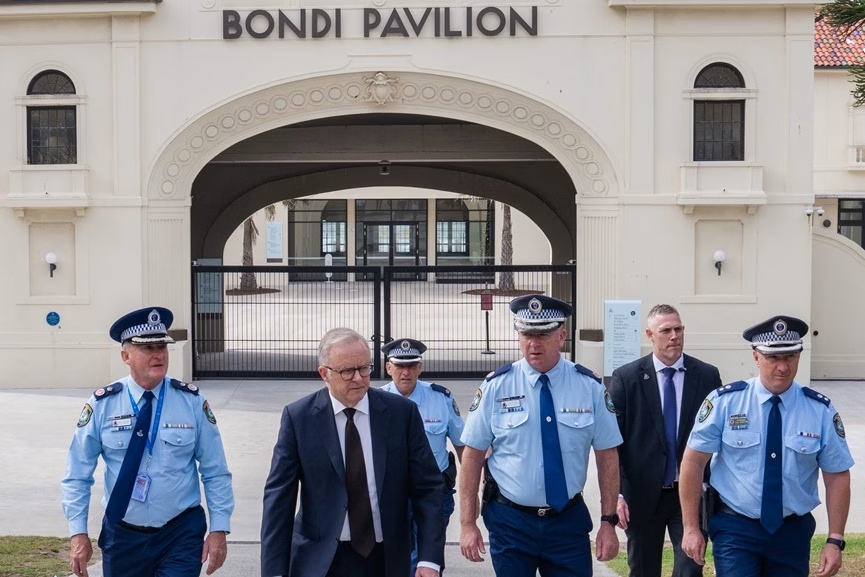
On Monday morning, Bondi Beach was unusually quiet. A makeshift memorial of flowers and Israeli and Australian flags grew near the pavilion as mourners gathered under heavy police presence. Jewish community security patrols were also visible.
My statement on the Bondi shooting attack. pic.twitter.com/LRAbMpcUEm
— Anthony Albanese (@AlboMP) December 14, 2025
The attack has deeply shaken Australia’s Jewish community, which numbers about 150,000 people nationwide, with a large concentration in Sydney’s eastern suburbs. It was the most severe incident in a series of antisemitic attacks reported across the country since the outbreak of the Gaza war in October 2023.
World leaders, including the presidents of the United States and France, sent messages of condolence. Albanese visited the site to lay flowers and described the shooting as an act of terrorism driven by antisemitism.
Mass shootings remain rare in Australia. The last incident of comparable scale occurred in 1996, when 35 people were killed at Port Arthur in Tasmania, a tragedy that led to sweeping gun reforms credited with preventing similar attacks for decades.
As investigations continue, Australia faces renewed questions about extremism, public safety and whether further tightening of gun controls is needed to prevent such violence from happening again.