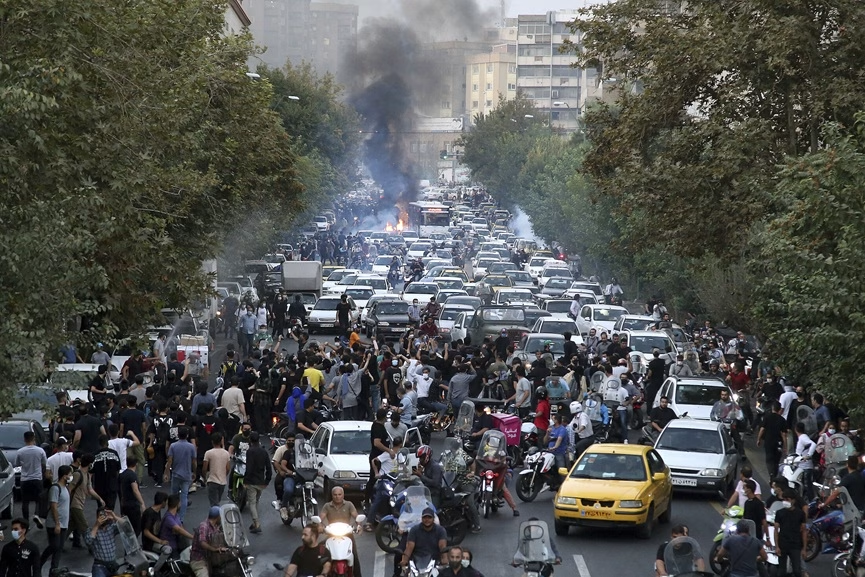


Dhaka: Bangladesh has set February 12 for its next parliamentary election, marking the first test of public will since the student-driven uprising that removed Sheikh Hasina and triggered a major political transition.
Chief Election Commissioner AMM Nasir Uddin confirmed the date in a televised address and said a national referendum on political reforms would take place the same day. The announcement comes as the caretaker government, led by Nobel laureate Muhammad Yunus, struggles to stabilise the political landscape amid continued pressure for reforms promised after Hasina’s ouster.
Hasina’s party remains barred from participating, and its senior leaders have warned that tensions could increase as campaigning progress. Yunus described the election schedule as a crucial step in restoring democratic rule. He said the country had reached an important milestone on the path opened by the mass uprising that reshaped Bangladesh’s political order.
Political strains deepened on Thursday after President Mohammed Shahabuddin, appointed during Hasina’s tenure, said he would resign once voting concludes.
Public expectations surrounding the vote remain high. Many voters are keen to rebuild democratic institutions, revive the garment-export sector, and repair relations with India, which deteriorated after Hasina fled there in the aftermath of the upheaval.
Statement of Bangladesh Awami League Rejecting the Election Schedule Announced by the Illegal Government’s Illegal Election Commission
The Bangladesh Awami League has closely reviewed the election schedule announced by the illegal, occupying, killer-fascist Yunus clique’s… pic.twitter.com/1uy9H2umag
— Bangladesh Awami League (@albd1971) December 11, 2025
Referendum to Decide Fate of ‘July Charter’ Reforms
Election officials say nearly 128 million citizens will be eligible to cast ballots at more than 42,000 polling stations in contests for 300 parliamentary seats. The referendum will determine whether the ‘July Charter,’ a reform blueprint drafted immediately after the uprising, becomes the basis for restructuring state institutions.
The Charter proposes reducing executive authority, strengthening judicial independence, reinforcing the election commission, and curbing the political misuse of law-enforcement agencies.
The Bangladesh Nationalist Party (BNP), led by former Prime Minister Khaleda Zia, is expected to dominate the race. The BNP is competing alongside Jamaat-e-Islami, which is returning to electoral politics for the first time since a 2013 court ruling barred it under the country’s secular constitution.
A new political group, the National Citizen Party, formed by student leaders who helped organise the 2024 uprising, has yet to build a national base despite its strong street mobilisation earlier in the year.
In a significant realignment, the BNP has formally ended its long-running alliance with Jamaat-e-Islami and is presenting itself as a liberal and democratic force in the post-Hasina era.