
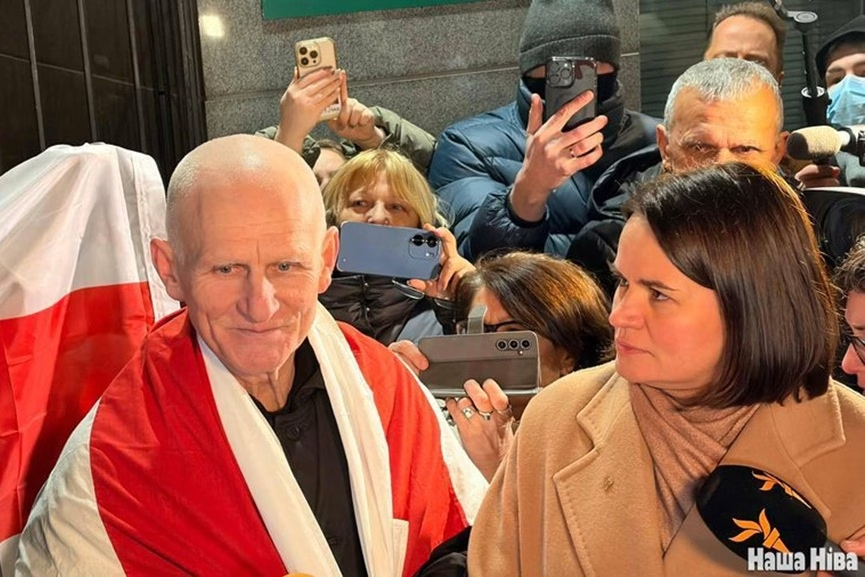
Belarus: Belarus has released 123 prisoners, including Nobel Peace Prize laureate Ales Bialiatski and prominent opposition leader Maria Kolesnikova, following a deal linked to sanctions relief from the United States.
The move marks the largest prisoner release ordered by President Alexander Lukashenko in years and comes after direct talks between Minsk and Washington. US special envoy for Belarus John Coale announced that sanctions on potash, a key Belarusian export used in fertilisers, were lifted after two days of negotiations in the Belarusian capital.
Belarus is one of the world’s leading producers of potash, and the easing of restrictions represents a significant economic concession. In return, Lukashenko agreed to free dozens of political detainees and other prisoners, many of whom had been held for years.
Ukraine’s prisoner of war coordination centre said it had received 114 of those released, including Ukrainian citizens accused of working for Ukrainian intelligence and Belarusian political prisoners. The remaining nine were taken to Lithuania. Ukrainian President Volodymyr Zelenskyy confirmed that five Ukrainian citizens were among those freed.
Today’s prisoner release is the result of brilliant 🇺🇸 diplomacy & consistent 🇪🇺 pressure. US efforts are saving lives. European sanctions can help save our country.
Pressure must continue until repression ends, all prisoners are free & Belarus can begin its democratic future. pic.twitter.com/j1VXRl7dxe
— Sviatlana Tsikhanouskaya (@Tsihanouskaya) December 13, 2025
The development signals a notable shift in relations between the United States and Belarus, which had been largely frozen since the disputed 2020 presidential election. Western governments refused to recognise Lukashenko’s victory, accusing him of widespread fraud and a brutal crackdown on dissent, followed by his support for Russia’s war in Ukraine.
Former Belarusian diplomat Pavel Slunkin said the prisoner release could help Lukashenko regain some international standing and ease his isolation. He added that Washington may lift further sanctions and encourage the European Union to consider a similar approach.
Exiled opposition leader Sviatlana Tsikhanouskaya welcomed the release and thanked the United States for its role, saying it showed sanctions could produce humanitarian results. At the same time, she stressed that European sanctions should remain in place to push for deeper political change, an end to the war in Ukraine and accountability for abuses.
I am glad to see an unbroken man, a Nobel Peace Prize laureate, and the founder of @viasna96, Ales Bialiatski, free. Thank you, @johnpcoale, for the tremendous work you have done.
In these moments of joy, we must remember how important it is to free around 1,200 political… pic.twitter.com/1HGuKpCoPU— Pavel Latushka (@PavelLatushka) December 13, 2025
US officials said the engagement with Minsk is part of a broader effort to reduce Belarus’s dependence on Russia, though the opposition has long viewed such outreach with caution. The US embassy in Lithuania said Washington remains committed to securing the release of those still detained.
Bialiatski, who won the Nobel Peace Prize in 2022 for his work defending political prisoners, was among those taken to Lithuania. His wife said he was in good health. The Nobel Committee expressed relief at his release and urged Belarus to free all remaining political prisoners.
Kolesnikova, a central figure in the 2020 protests against Lukashenko, was taken to Ukraine along with other freed detainees. In a video shared after her release, she spoke of the joy of seeing loved ones again and experiencing freedom for the first time in years. She was also reunited with former presidential hopeful Viktar Babaryka, who remains separated from his son, still imprisoned in Belarus.