
Beijing: China is preparing to take an unusual step at its southern frontier by putting humanoid robots to work along the border with Vietnam, using them for patrols and logistics in one of the country’s busiest cross-border zones.
The project will be led by Shenzhen-based UBTECH Robotics Corp, which has secured a $37 million contract to deploy its Walker S2 humanoid robots starting this month. The rollout, planned for Fangchenggang in Guangxi, will mark the first large-scale deployment of humanoid robots for border-related tasks in China.
Fangchenggang is a key coastal gateway near Vietnam, handling heavy flows of cargo, trucks, buses, and travellers each day. The robots are expected to support routine patrols, assist with logistics, guide travellers, and help manage crowds, particularly in high-traffic areas where human resources are often stretched.
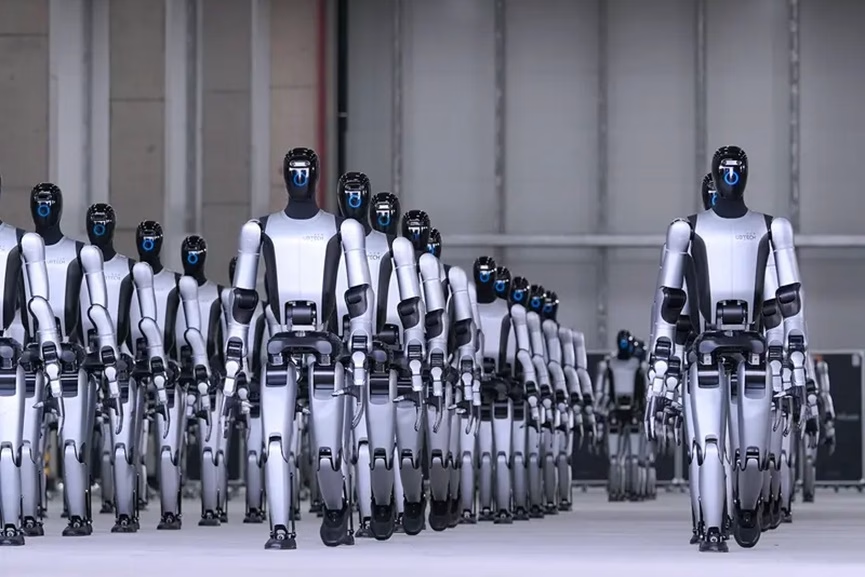
Built for industrial use, the Walker S2 is an adult-sized humanoid machine with a human-like structure, including legs, arms, and a torso. It runs on UBTECH’s BrainNet 2.0 system, which allows it to process visual and spatial information, make decisions on its own, and operate in complex, real-world environments. The robot can move through spaces designed for people, giving it flexibility that wheeled machines lack.
A notable feature of the Walker S2 is its ability to swap its own batteries without human help, allowing it to operate for extended periods. It can bend up to 125 degrees and carry loads of up to 15 kilograms within a working height of 1.8 metres. The vision system combines binocular cameras with depth sensors, while force feedback in its joints helps it maintain balance, track nearby movement, and avoid collisions.
They said it looked too perfect to be real.
But perfection isn’t fabricated—it’s delicately engineered.
This is the historic mass delivery of UBTECH (优必选) Walker S2.
The next era of intelligent manufacturing is here.
Let’s build it together!#WalkerS2 #HumanoidRobots… pic.twitter.com/aFzjw4qM0g— UBTECH Robotics (@UBTECHRobotics) November 14, 2025
The border deployment is part of a much wider push by China to scale up the use of humanoid robots. UBTECH plans to build 5,000 units by the end of 2026 and increase production to 10,000 units by 2027. These robots are expected to find roles in car factories, smart manufacturing lines, logistics hubs, and large-scale data collection operations.
Humanoid robotics has been identified by Beijing as a strategic industry. The Ministry of Industry and Information Technology opened consultations last year to draft rules for the sector, while a robot training centre in Beijing’s Shijingshan district has been set up to collect performance data and refine capabilities.
Still, the rapid expansion has prompted caution. Economic planners have warned against over-investment at a time when the technology is still maturing. Cybersecurity specialists have also flagged risks, noting that complex AI-driven systems can be vulnerable if not carefully secured.