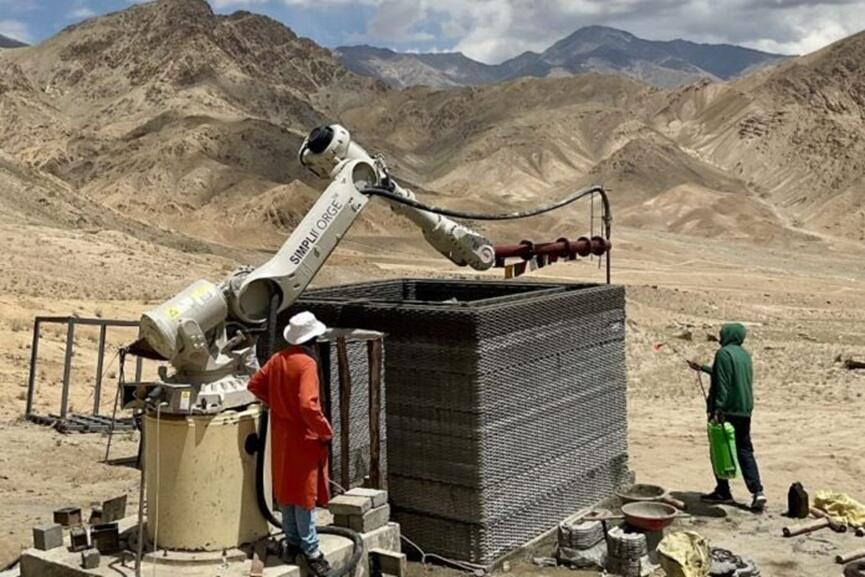
Hyderabad: India has unveiled its first-ever 3D-printed military bunker at 11,000 feet in Leh, created using homegrown tech by the Indian Army, IIT-Hyderabad, and Simpliforge Creations.
Set at an altitude of 11,000 feet, the bunker was developed under Project PRABAL using fully Indigenous technology.
The structure was built in high-altitude, low-oxygen (HALO) conditions, a first in the realm of 3D-printed construction globally.
This initiative not only showcases India’s growing technological prowess but also signals a new era in rapid deployment of strategic infrastructure in remote and rugged terrains.
Technological Breakthrough
The project was headed by Prof. KVL Subramaniam from IIT-Hyderabad, whose team led the research, testing, and material development. “We constructed this military bunker using locally sourced materials, specially adapted for extreme conditions. This marks a new chapter for both the defense and construction sectors in India,” Prof. Subramaniam stated.
Extensive laboratory testing was conducted at IIT-H’s state-of-the-art facilities, including rheology studies and detailed analysis of local sand and aggregates.
These efforts led to the development of a custom concrete mix that ensures high strength, resilience, and durability, tailored specifically for high-altitude operational challenges.
Under Project PRABAL (Portable Robotic Arm for the Construction of Bunkers and AnciLlaries) 🇮🇳IIT Hyderabad along with 🇮🇳Simpliforge Creations took a total printing time of 14 hours to build a 3D-printed protected military bunker in Leh🇮🇳 (at 11000ft) for Indian Army.
📹IIT-H pic.twitter.com/SzsLV74p4J
— Hero For Fun (@XClassHero) April 18, 2025
Construction Using Robotic 3D Printing
Dhruv Gandhi, CEO of Simpliforge Creations, highlighted the speed and innovation behind the project. “We deployed a robotic 3D printer to construct the structure within 24 hours. The entire bunker was completed in just five days,” he said.
The bunker’s design was engineered to withstand the extreme climate and functional demands of the region.
Project PRABAL aligns with India’s broader vision of Atmanirbhar Bharat (self-reliant India), showcasing how indigenous R&D and private-sector collaboration can drive strategic innovation.
Defense experts believe the successful execution of this project could pave the way for more such structures in high-conflict or inaccessible zones, significantly reducing the time and manpower required for conventional construction.