
Florida: NASA’s Artemis II crew returned safely to Earth after completing humanity’s first crewed journey around the Moon in more than half a century.
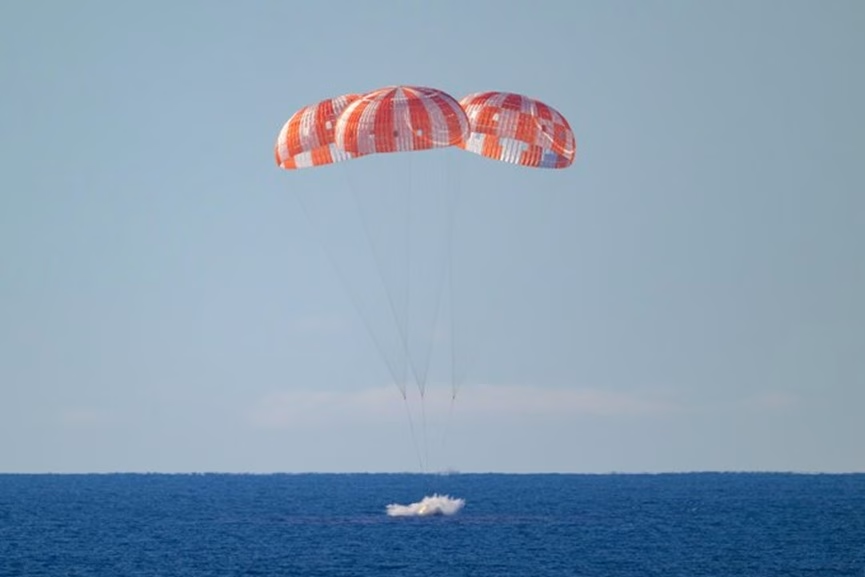
The Orion spacecraft splashed down in the Pacific Ocean off the California coast on Friday evening, ending a landmark 10-day mission that carried astronauts farther from Earth than any human crew has traveled since the Apollo era.
On board were NASA astronauts Reid Wiseman, Victor Glover, Christina Koch, and Canadian astronaut Jeremy Hansen.
A Fiery Return, A Safe Landing
The most dangerous part of the mission came in the final minutes. As Orion re-entered Earth’s atmosphere at tremendous speed, temperatures on the capsule’s outer shell soared to nearly 2,760 degrees Celsius.
The intense heat briefly cut communication with mission control, a planned but tense phase caused by plasma forming around the spacecraft.
Minutes later, contact returned. Parachutes opened successfully, slowing Orion before it touched down gently in the ocean, where recovery crews were already waiting.
When the hatch was opened, the astronauts emerged tired but healthy, bringing an end to a journey that tested both human endurance and spacecraft engineering.
Welcome home Reid, Victor, Christina, and Jeremy! 🫶
The Artemis II astronauts have splashed down at 8:07pm ET (0007 UTC April 11), bringing their historic 10-day mission around the Moon to an end. pic.twitter.com/1yjAgHEOYl
— NASA (@NASA) April 11, 2026
First Moon Voyage in More Than 50 Years
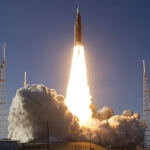
Launched from Kennedy Space Center, Artemis II marked the first time since the Apollo missions that astronauts traveled around the Moon and returned safely home.
The mission did not land on the lunar surface. Instead, it served as a crucial test of Orion’s life support systems, navigation controls, and heat shield—all vital for future Moon landings.
During their flight around the far side of the Moon, the crew captured rare views of the lunar surface, witnessed a solar eclipse, and observed meteorite impacts, offering fresh scientific insight and unforgettable images.
Our crew on the @Space_Station caught a glimpse of the @NASAArtemis II crew as they re-entered the atmosphere from their journey to the Moon! We first saw a bright light and a trail as the service module burned up. We didn’t see the Orion capsule itself as it re-entered, but we… pic.twitter.com/4uzu3wBefB
— Chris Williams (@Astro_ChrisW) April 11, 2026
Historic Milestones in Spaceflight
The mission also broke new ground in representation. Glover became the first Black astronaut to travel around the Moon, Koch the first woman, and Hansen the first non-American astronaut to complete such a mission.
Before re-entry, Commander Wiseman shared one final reflection from space, speaking of Earth’s fragile beauty and urging people to value the planet they call home.
Artemis II is more than a successful mission — it is the foundation for what comes next.
NASA engineers will now study data gathered during the flight, especially Orion’s performance during re-entry. Those findings will help shape Artemis III and Artemis IV, missions expected to carry astronauts back to the lunar surface in the coming years.