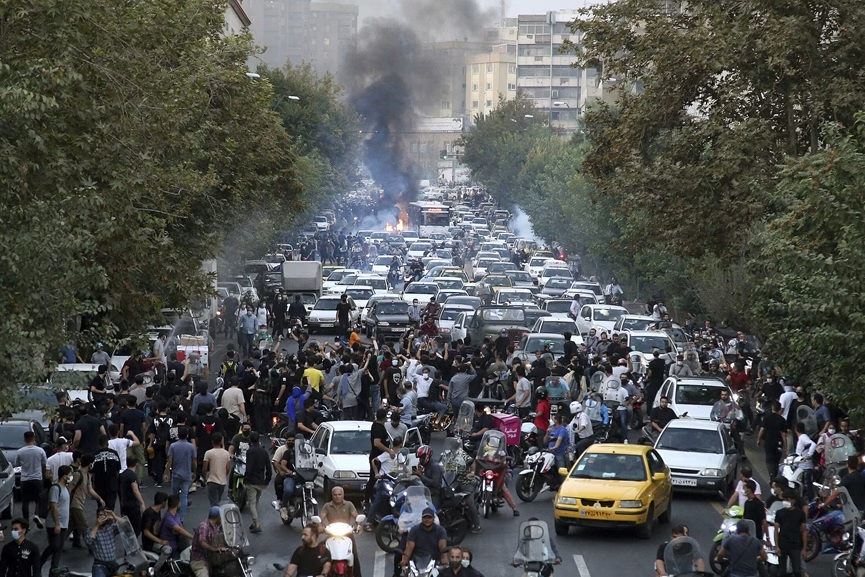

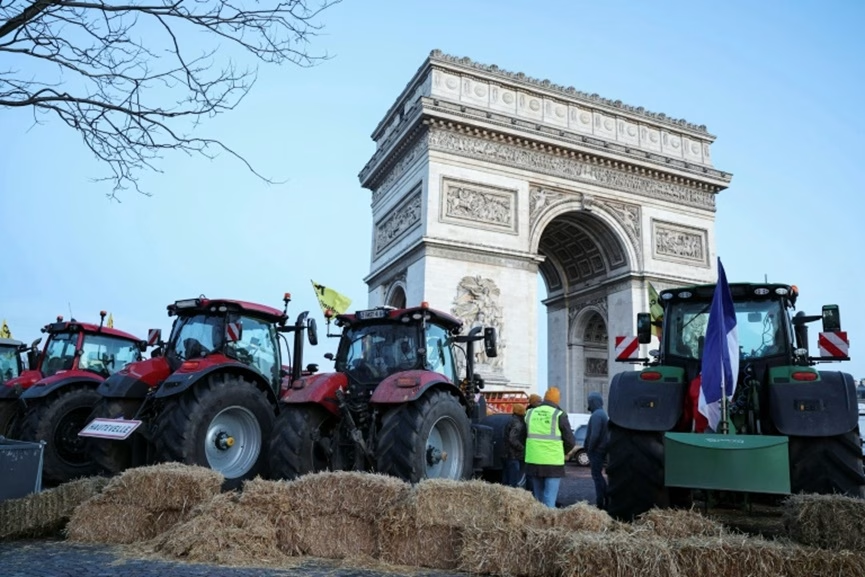
Paris: French farmers driving tractors blocked key roads around the Eiffel Tower and the Arc de Triomphe, staging a dramatic protest against a proposed European Union trade deal with South American nations that they say threatens their livelihoods.
Dozens of tractors pushed through police checkpoints before dawn to reach central Paris, as farmers linked to the Coordination Rurale union blockaded major motorways leading into the capital. Similar protests have been seen elsewhere in Europe, with Belgian farmers rolling more than 1,000 tractors into Brussels last month.
The demonstrations come a day before EU member states are due to vote on a long-negotiated trade agreement with Argentina, Brazil, Uruguay, and Paraguay, the four countries that make up the Mercosur bloc. If approved, the deal would create a market of nearly 800 million people and is expected to boost European exports of cars, machinery, wines, and spirits.
Farmers across the EU fear the agreement will open the door to cheaper agricultural imports, undercutting European producers who face higher costs and stricter environmental rules. A senior Coordination Rurale figure said farmers felt abandoned and increasingly desperate, pointing to the Mercosur deal as a symbol of that frustration.
French President Emmanuel Macron said that France will vote against the proposed free trade agreement with the Mercosur bloc when the issue comes up for a decision on Friday.
La France est favorable au commerce international, mais l’accord UE-Mercosur est un accord d’un autre âge, négocié depuis trop longtemps sur des bases trop anciennes (mandat de 1999).
Si la diversification commerciale est nécessaire, le gain économique de l’accord UE-Mercosur…
— Emmanuel Macron (@EmmanuelMacron) January 8, 2026
In a post on social media platform X, Macron said there was broad political opposition in France to the deal, despite significant concessions made for European farmers. He added that the vote would not mark the end of France’s efforts, saying he would continue to push for the full enforcement of commitments secured from the European Commission and for stronger protection of French farmers.
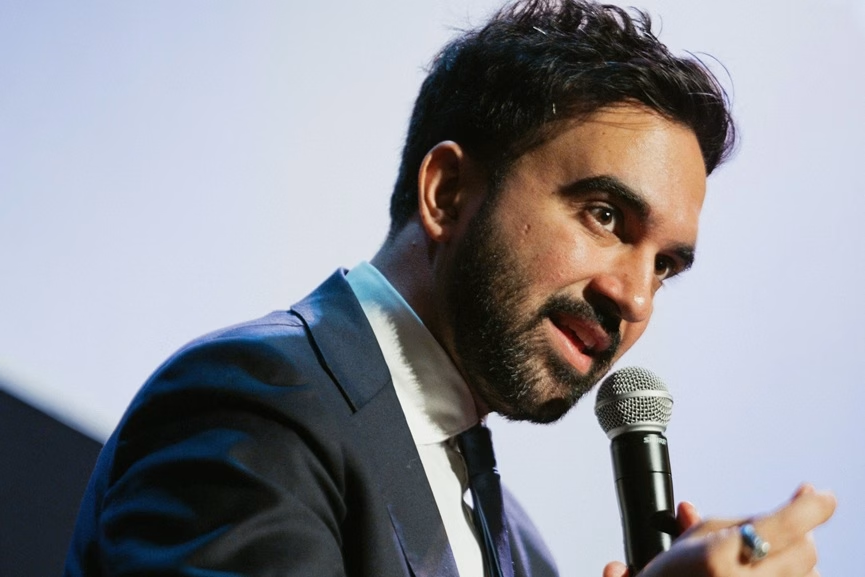
Ireland is also set to oppose the agreement, with Deputy Prime Minister Simon Harris confirming Dublin’s position earlier. However, the deal is still expected to pass after the European Commission secured Italy’s backing, giving it the numbers needed for approval.
Macron’s comments came as French farmers staged tractor protests across Paris, blocking key roads and areas around landmarks such as the Arc de Triomphe in opposition to the EU-Mercosur trade pact.
French authorities warned they would not tolerate illegal blockades. The government said attempts to block roads or gather outside parliament were unlawful, as police maintained a heavy presence around key protest sites. Farmers later demonstrated outside the lower house of parliament, heckling its president when she came out to address them.
France has long opposed the Mercosur agreement, unlike Germany and Spain, which support it. Paris has secured several concessions but remains cautious, particularly with municipal elections approaching in March. The government has maintained that the treaty, in its current form, remains unacceptable and said France would continue to oppose it in the European Parliament even if it clears the next hurdle.
French farmers enter Paris, they are opposing a push to conclude a trade deal between EU and South American nations within Mercosur, it has reignited rural discontent over unfair competition, burdensome regulations & low farm income.
No one is calling French farmers “terrorists” pic.twitter.com/H805rnqAzN
— Ramandeep Singh Mann (@ramanmann1974) January 8, 2026
Negotiations on the deal have dragged on for 26 years, gaining momentum in recent years amid global trade tensions and growing competition from China. The agreement was signed in late 2024 by European Commission President Ursula von der Leyen, despite objections from France, Poland, and other countries, but it still requires approval from EU governments and lawmakers.
Under the deal, South American countries would cut tariffs on European goods such as cars, clothing, medicines, and fine wines. In return, the EU would allow more agricultural imports, though with limits on products such as beef, pork, sugar, honey, and ethanol.
To ease concerns, the European Commission has proposed making an additional €45 billion available for farmers in the bloc’s next seven-year budget, offsetting planned cuts to agricultural funding. France is still pushing for tougher safeguards, including the ability to reimpose tariffs more quickly if prices fall sharply and stricter rules on pesticide standards.
Italy, whose position had been uncertain, appears to have shifted in favour of the deal, with Prime Minister Giorgia Meloni praising a pragmatic approach to supporting European agriculture. Analysts say Italy’s backing could be enough to secure approval by a qualified majority of member states, even without French support.
Under EU rules, at least 15 of the bloc’s 27 countries, representing 65 per cent of its population, are needed to approve the agreement. Without Italy’s support, France and a small group of allies would struggle to block the deal when the vote takes place on Friday.