
Washington: US President Donald Trump has raised global import tariffs to 15 percent, days after the Supreme Court of the United States struck down his earlier broad-based levies as unconstitutional.
The decision marks a significant escalation in the ongoing confrontation between the White House and the judiciary over the scope of presidential trade authority. The Supreme Court, in a 6–3 ruling, held that Trump had exceeded his constitutional powers by imposing broad tariffs under emergency legislation, affirming that the authority to levy taxes rests with Congress.
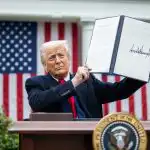
Undeterred, the president moved quickly to reassert his trade agenda. Within hours of the ruling, he invoked Section 122 of the Trade Act of 1974, signing an executive order to impose a temporary 10 percent blanket tariff. On Saturday, he raised that rate to 15 percent — the maximum permitted under the statute.
Unlike the earlier measures struck down by the court, Section 122 allows the president to impose tariffs for up to 150 days to address balance-of-payments concerns. No previous administration has relied on this provision in such sweeping fashion, setting the stage for potential new legal challenges.
The White House confirmed that exemptions would apply to selected goods, including critical minerals, metals, and certain energy products.
Legal and Financial Repercussions
The Supreme Court’s ruling has triggered a surge of litigation. Federal figures indicate that more than $133 billion had already been collected under tariffs imposed through the International Emergency Economic Powers Act (IEEPA) before they were struck down. Importers across the United States are now filing claims seeking repayment.
Legal experts suggest that while larger corporations may eventually secure refunds, smaller firms could face procedural hurdles and prolonged uncertainty.
The implications extend well beyond US borders. Trade agreements negotiated under the previous tariff regime, including arrangements with Taiwan and the United Kingdom, now face renewed scrutiny. Some negotiated rates exceed the newly announced 15 percent level, complicating enforcement and raising questions about consistency in US trade commitments.
Countries such as Malaysia, Cambodia, and Indonesia have signaled that their agreements with Washington remain in effect. Others without revised deals could temporarily benefit from lower tariff exposure.
Keep calm. pic.twitter.com/Mj5ptXqPxT
— The White House (@WhiteHouse) February 20, 2026
Political Stakes Rising
With midterm elections approaching, Trump’s economic stewardship has come under sharper examination. A recent Reuters/Ipsos survey showed public approval of his handling of the economy trailing disapproval by a wide margin.
Democratic lawmakers have criticized the latest move, arguing that higher import duties ultimately burden American consumers and businesses.
California Governor Gavin Newsom described the decision as economically damaging, while members of the House Ways and Means Committee accused the administration of undermining the court’s authority.