
Tehran: Iran has begun a 40-day national mourning period following the killing of Supreme Leader Ayatollah Ali Khamenei in the coordinated attacks by the United States and Israel.
The strikes, which also claimed the lives of senior security officials and members of Khamenei’s family, mark one of the most consequential blows to the Islamic Republic’s leadership structure since the 1979 revolution.
President Masoud Pezeshkian condemned the killing as ” a great crime” and announced seven days of public holidays in addition to the extended mourning period.
State media reported that public ceremonies are expected across the country, even as security concerns persist amid continued regional tensions.
Public Grief and Divided Reactions
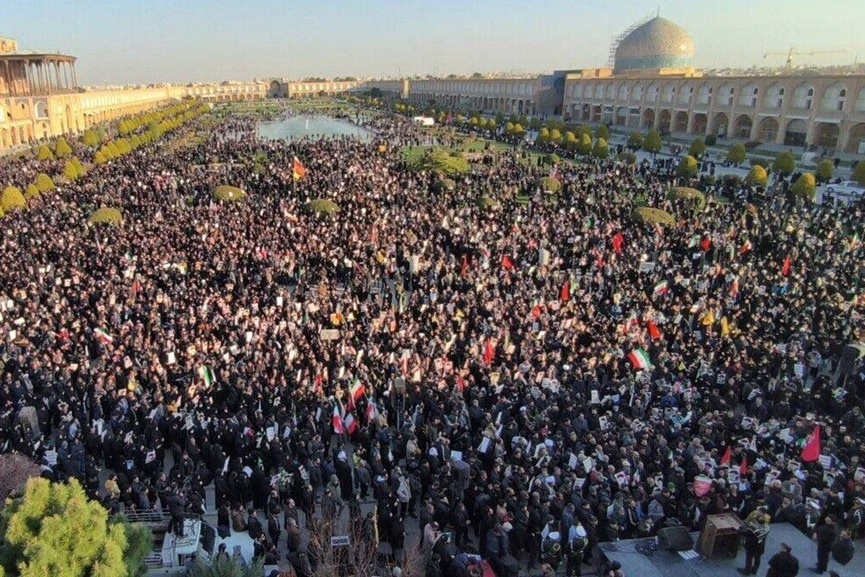
Scenes of mourning unfolded in Tehran and other cities, with crowds gathering in public squares and religious sites. Footage broadcast by state media showed emotional scenes at the shrine of Imam Reza in Mashhad, where supporters were seen weeping openly.
Protests denouncing the killing were reported in Shiraz, Yasuj, and Lorestan. Meanwhile, regional solidarity was evident in neighboring Iraq, which declared three days of public mourning. In Baghdad, demonstrators clashed with security forces in the fortified Green Zone, home to government institutions and foreign embassies.
However, international media agencies cited witnesses reporting isolated celebrations in parts of Tehran, Karaj, and Isfahan, underscoring deep political divisions within Iranian society.
Leader of the Islamic Revolution Ayatollah Seyyed Ali Khamenei was martyred in Israeli-American attack on Saturday. pic.twitter.com/dx80n47GoR
— IRNA News Agency ☫ (@IrnaEnglish) March 1, 2026
Interim Leadership Structure Activated
According to the official IRNA news agency, a three-member council comprising the president, the judiciary chief, and a jurist from the Guardian Council has assumed temporary leadership responsibilities. The body will oversee state affairs until a new supreme leader is selected under constitutional provisions.
The transition mechanism reflects the system established after the death of Ayatollah Ruhollah Khomeini in 1989, when Khamenei ascended to the country’s highest office. While Khomeini was regarded as the ideological architect of the revolution that toppled the Pahlavi monarchy, Khamenei consolidated the country’s military and paramilitary structures, expanding Iran’s regional footprint and reinforcing domestic control.
Escalation Across the Region
The killing has intensified hostilities across the Middle East. The Islamic Revolutionary Guard Corps (IRGC) vowed retaliation, announcing strikes on 27 bases hosting US troops and Israeli military facilities in Tel Aviv. Explosions and security alerts have since been reported in Qatar and the United Arab Emirates.
US President Donald Trump warned Iran against further retaliation, stating on social media that any response would be met with unprecedented force.
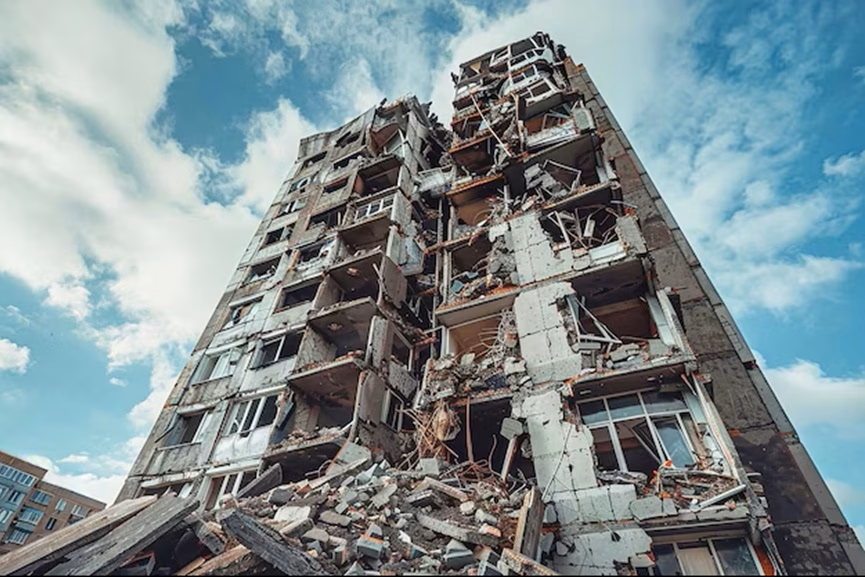
Iranian state media reported that at least 201 people were killed in joint US-Israeli strikes across 24 provinces. In southern Iran, officials said 148 people were killed and 95 wounded in a strike on an elementary school in Minab, with casualties expected to rise.
Strategic analysts have cautioned that the removal of Iran’s supreme leader may not produce immediate political concessions. Harlan Ullman, chairman of the Killowen Group and adviser to the Atlantic Council, suggested that leadership decapitation strategies rarely succeed unless all key power centers are neutralized, warning that Tehran is unlikely to pursue negotiations in the near term.
Khamenei’s death represents a watershed moment for the Islamic Republic. Having assumed leadership in 1989, he presided over decades of geopolitical confrontation, economic sanctions, and internal political consolidation.
The coming weeks will test Iran’s constitutional mechanisms, social cohesion, and regional alliances as it navigates one of the most volatile chapters in its post-revolutionary history.