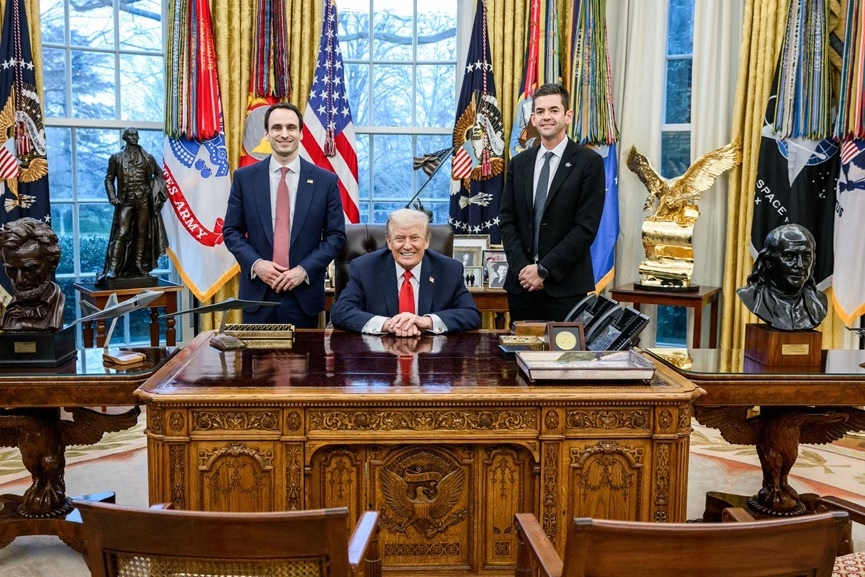
Washington: President Donald Trump issued an executive order aimed at returning humans to the moon by 2028 and strengthening US defense against space-based threats.
The move marks the first major space policy action of his administration’s second term. The order, titled Ensuring American Space Superiority, was released hours after billionaire Jared Isaacman was sworn in as NASA’s 15th administrator.
It directs the Pentagon and US intelligence agencies to develop a comprehensive space security strategy, promotes efficiency among private contractors, and calls for demonstrations of missile-defense technologies under Trump’s Golden Dome program.
Today, President Trump established the most significant national space policy since the Kennedy era. @POTUS made a commitment to return to the Moon, establish an enduring presence, invest in the technology of the future and pursue the secrets of the universe. @NASA, with a… pic.twitter.com/5s5atM6RLz
— NASA Administrator Jared Isaacman (@NASAAdmin) December 18, 2025
The initiative also reshuffles national space policy coordination, placing it under Chief Science Adviser Michael Kratsios. While it initially appeared to dissolve the National Space Council, a top-level White House panel, officials clarified that it will continue under the Office of Technology Policy with a new structure chaired directly by the president.
Trump’s lunar timeline echoes his 2019 directive to land astronauts on the moon by 2024, a target widely regarded as ambitious. Delays in NASA’s Space Launch System and SpaceX’s Starship have pushed the goal to 2028, aligning with the timeline set under former President Barack Obama.
Space has been a lifelong passion of mine. I’m grateful to President Trump for giving me the opportunity to serve alongside the best and brightest at NASA.
It was an honor to have stood with @mkratsios47 as @POTUS signed the most impactful executive space policy in generations.… pic.twitter.com/u0WH5ciOun
— NASA Administrator Jared Isaacman (@NASAAdmin) December 19, 2025
The executive order emphasizes the establishment of a long-term lunar presence, calling for the initial elements of a permanent lunar outpost to be established by 2030. This initiative positions the US in direct competition with China, which has set a 2030 target for its first crewed moon landing.
Isaacman, who will address NASA employees agency-wide on Friday, has stressed pursuing both lunar and Martian missions simultaneously while prioritizing the moon to maintain US leadership in space. The White House has already reduced NASA’s workforce by 20 percent and proposed a roughly 25 percent budget cut for 2026, raising concerns about the future of several space-science programs.