
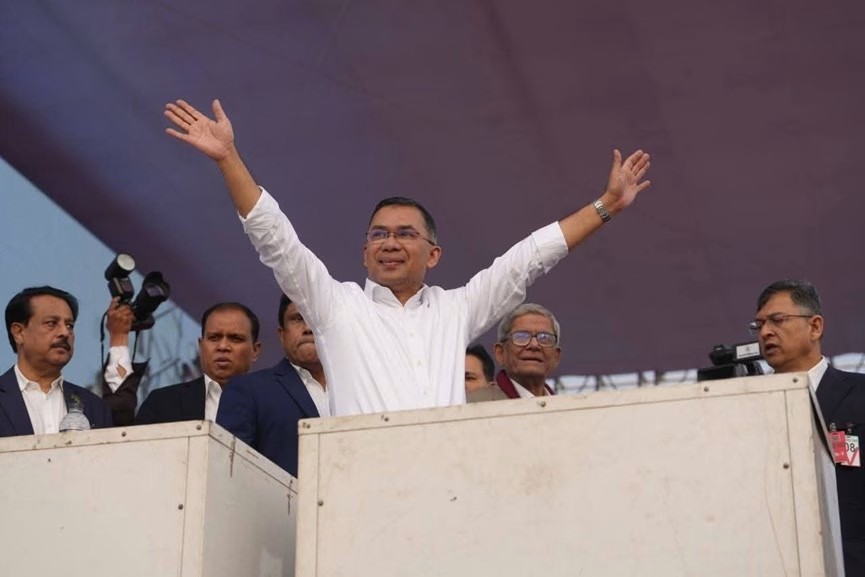
Dhaka: After 17 years in self-imposed exile in London, Tarique Rahman has returned to Bangladesh’s political center stage, leading the Bangladesh Nationalist Party (BNP) to a commanding electoral victory that signals a dramatic shift in the country’s power landscape.
The BNP secured 209 of the 297 contested parliamentary seats, marking its return to power after two decades. Right-wing Jamaat-e-Islami won 68 seats. The Awami League, led by former Prime Minister Sheikh Hasina, was barred from contesting the polls. Voter turnout stood at 59.44 percent.
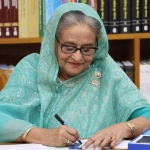
The result marks a striking reversal for the BNP, which had spent years under intense pressure during the 15-year rule of Hasina’s government, brought down by nationwide student-led protests in August 2024.
A Renewed Political Legacy
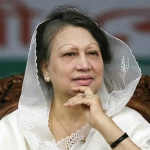
Tarique Rahman, 60, is the son of Bangladesh’s former President and BNP founder Ziaur Rahman and former Prime Minister Khaleda Zia. The party was formed by Ziaur Rahman after he transitioned from military ruler to politician. Following his assassination in 1981, Khaleda Zia led the BNP for nearly four decades.
Rahman returned to Dhaka in December to a massive reception. Just five days later, he suffered a personal loss when his mother passed away after a prolonged illness. He assumed full leadership of the party at a moment when it was struggling to regain political ground.
Though often described as a product of dynastic politics, Rahman has gradually shaped his own leadership style. During the campaign, he adopted a measured tone, avoiding inflammatory rhetoric and urging restraint, even in the face of bitter rivalries with the deposed Awami League establishment.
The Bangladesh Nationalist Party (BNP) has long struggled to restore the people’s right to vote in Bangladesh. In this struggle, we have lost countless leaders and activists; many fell victim to enforced disappearance and systemic repression.
Yesterday was the long-awaited… pic.twitter.com/CVuSv52MmX
— Bangladesh Nationalist Party-BNP (@bdbnp78) February 13, 2026
From Controversy to Comeback
Born on November 20, 1965, in Dhaka, Rahman witnessed Bangladesh’s 1971 liberation war as a child. He and his family were briefly detained during the conflict and released on the day of independence.
He studied international relations at the University of Dhaka but did not complete his degree, later venturing into textile and agro-based businesses. He became Senior Vice-Chairman of the BNP in 2009 and played a central role in reorganizing the party.
During the Awami League’s tenure, Rahman faced multiple corruption and criminal cases, including a life sentence in connection with the 2004 grenade attack on a rally of Sheikh Hasina that killed 24 people. He denied all allegations, calling them politically motivated. Following Hasina’s ouster, he was acquitted during the interim administration led by Muhammad Yunus.
His years abroad appear to have reshaped his public persona. Critics who once viewed him as a forceful backroom operator during the BNP’s 2001–2006 government now describe a more restrained and reflective leader.
Thank you very much, Honourable @narendramodi. We greatly appreciate your kind acknowledgment of Mr. Tarique Rahman’s leadership in securing the BNP’s decisive win in the national elections. This outcome reflects the trust and confidence the people of Bangladesh have placed in… https://t.co/hJAOguIvKZ
— Bangladesh Nationalist Party-BNP (@bdbnp78) February 14, 2026
The Road Ahead
Rahman has outlined an agenda focused on economic recovery and institutional reform. He has pledged to recalibrate Bangladesh’s foreign partnerships to attract investment while avoiding overdependence on any single power.
His proposals include financial support for low-income families through ‘family cards,’ diversifying exports beyond garments to sectors such as toys and leather goods, and introducing a two-term or 10-year limit for prime ministers.
The challenges are formidable. Bangladesh’s economy remains fragile, and analysts warn that internal discipline within the BNP will test his leadership. Over the past 18 months, sections of party activists were accused of extortion and targeting political rivals. Media reports said the BNP expelled around 10,000 members over misconduct allegations.
Still, the scale of the electoral mandate gives Rahman a strong starting point. For many supporters, his return symbolizes political renewal after years of polarization.