

New Delhi: India’s position as a rising global technology hub received a major boost this week as Amazon and Microsoft announced a combined investment plan worth $52.5bn over the coming years. The commitments strengthen India’s ambition to become a leading centre for artificial intelligence and cloud infrastructure.
Amazon said that it will invest $35bn in India by 2030 to increase AI-driven digitisation, expand exports, and support large-scale job creation. The move comes a day after Microsoft pledged $17.5bn to deepen the country’s AI capabilities and build critical digital infrastructure.
The announcements follow a wave of global tech interest in India. In October, Google committed $15bn to develop an AI data hub, while Intel revealed a major partnership with Tata Electronics as part of Tata’s $14bn semiconductor manufacturing programme.
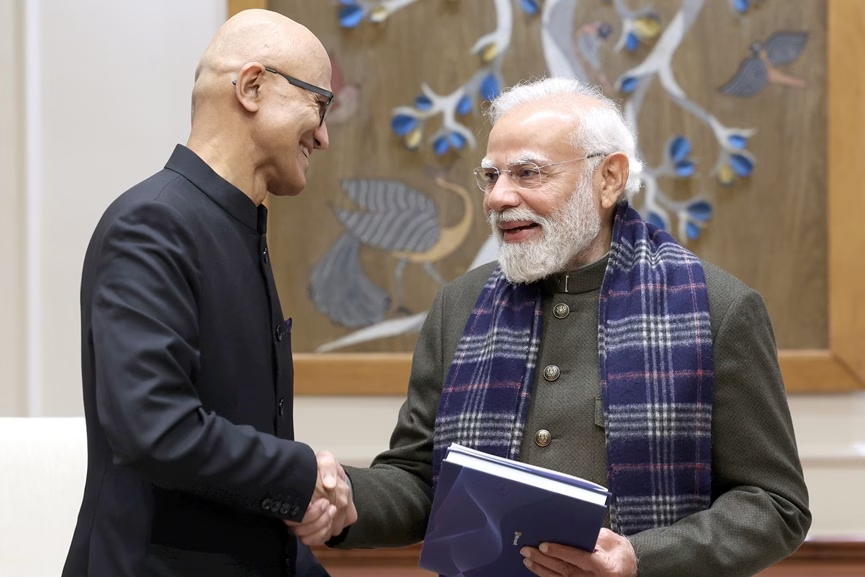
After meeting Microsoft chief executive Satya Nadella, Prime Minister Narendra Modi said the world is increasingly optimistic about India’s role in shaping the future of AI.
Amazon’s new commitment builds on the $40bn it has already invested in India, which it says makes it the largest foreign investor in the country. A significant portion of the new investment will be allocated to local cloud services and AI infrastructure.
Microsoft’s latest pledge follows a $3bn investment announced earlier this year. It includes plans for a hyperscale cloud region in Hyderabad, a cluster of large data centres scheduled to become operational in mid-2026.
When it comes to AI, the world is optimistic about India!
Had a very productive discussion with Mr. Satya Nadella. Happy to see India being the place where Microsoft will make its largest-ever investment in Asia.
The youth of India will harness this opportunity to innovate… https://t.co/fMFcGQ8ctK
— Narendra Modi (@narendramodi) December 9, 2025
India will also gain access to Microsoft’s sovereign public cloud, a platform designed to help organisations run applications and store sensitive data entirely within national borders. The investment forms part of Microsoft’s broader $23bn AI expansion strategy across several countries, including Canada, Portugal, and the UAE. The company also aims to support India’s digital public systems by integrating AI into government platforms used by millions of informal workers.
India is simultaneously increasing efforts to build a domestic semiconductor industry. Government-backed incentives and private sector initiatives are driving major chipmaking plans, a critical step as the country seeks self-reliance in key technologies.
Although India is home to a billion internet users and a vast engineering workforce, it remains behind global AI leaders such as China and the United States. However, increasing foreign investment, ambitious policy programmes, and a focus on strategic technologies are rapidly shifting the landscape.