

New Delhi: Indian Finance Minister Nirmala Sitharaman presented the Union Budget for 2026-27 in the Lok Sabha, creating history as the first Union Budget to be delivered on a Sunday since India’s Independence.
Dressed in a purple Kanjeevaram saree with golden checks and a coffee-brown border, Sitharaman marked yet another milestone by presenting her ninth consecutive Budget, the highest by any woman finance minister. This also makes it the 15th Budget of the Narendra Modi-led government.
Her budget speech, lasting one hour, 25 minutes, and 45 seconds, was firm and business-like in tone. She opened with an invocation marking the occasion of Magh Purnima and Guru Ravidas, before moving swiftly into policy priorities centred on growth, investment, and reform. The speech was notably free of poetic references or cultural quotations, reflecting a sharp focus on economic objectives.
This year’s Budget was also the first to be prepared at Kartavya Bhavan, the new headquarters of the finance ministry, following its shift from the historic North Block. Sitharaman described the Budget as being guided by three core duties, or Kartavya, aimed at accelerating economic growth, fulfilling the aspirations of citizens, and ensuring inclusive access to opportunities across regions and sectors.
The Union Budget reflects the aspirations of 140 crore Indians. It strengthens the reform journey and charts a clear roadmap for Viksit Bharat.#ViksitBharatBudget https://t.co/26hIdizan9
— Narendra Modi (@narendramodi) February 1, 2026
A major highlight was the sharp push to capital expenditure. The government raised capex by about 9 percent to Rs 12.2 lakh crore for FY27, underlining its commitment to infrastructure-led growth. Defence spending also saw a significant increase, with the allocation rising to Rs 7.84 lakh crore, signalling a strong focus on military modernisation and operational preparedness.
The finance minister also announced the proposal to set up a high-powered Education to Employment and Enterprise Standing Committee, tasked with recommending measures to strengthen the services sector as a key driver of the Viksit Bharat vision.
Throughout the speech, treasury benches frequently applauded the announcements, while opposition members remained largely subdued. The Budget included limited but strategic references to states heading into elections, without overt populist signals.
Addressing the broader economic context, Sitharaman acknowledged growing global challenges, including disruptions to trade, stressed supply chains, rapid technological shifts, and rising demand for critical resources such as energy and minerals. She underlined that India must balance ambition with inclusion while staying deeply integrated with global markets to boost exports and attract long-term investment.
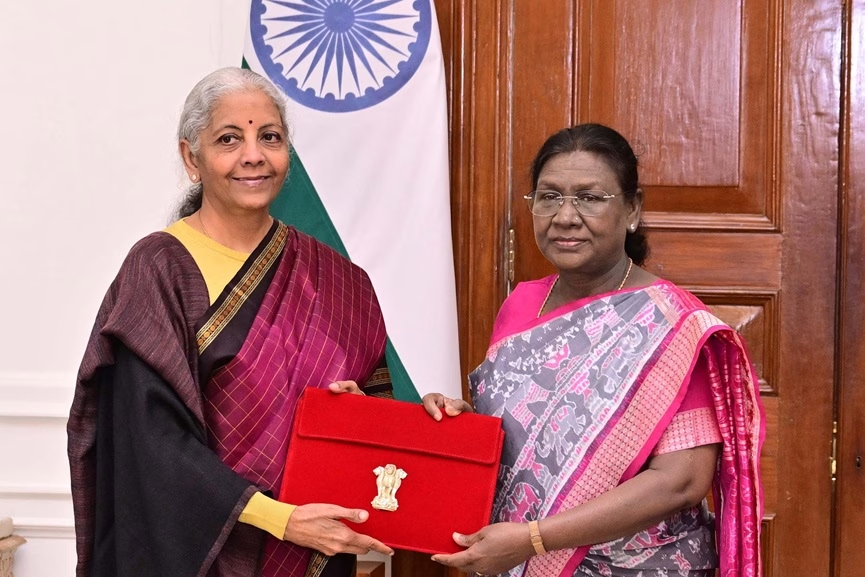
Union Minister for Finance and Corporate Affairs Smt Nirmala Sitharaman along with Minister of State for Finance Shri Pankaj Chaudhary and senior officials of the Ministry of Finance called on President Droupadi Murmu at Rashtrapati Bhavan before presenting the Union Budget. The… pic.twitter.com/XhBbxwFeAS
— President of India (@rashtrapatibhvn) February 1, 2026
The Budget comes at a complex moment for the economy. While domestic demand remains resilient and inflation has eased, global uncertainties continue to pose risks. Geopolitical tensions, volatile commodity prices, uneven monetary policy across major economies, and rising trade fragmentation are weighing on growth prospects. The recent imposition of steep tariffs by the United States on Indian goods has further unsettled markets, contributing to foreign fund outflows and pressure on the rupee.
Despite these headwinds, earlier income tax and GST cuts, higher infrastructure spending, and interest rate reductions by the Reserve Bank of India have helped cushion the economy. However, these measures have also tightened government revenues, limiting fiscal space in the current Budget.
In her post-Budget remarks, Sitharaman emphasised the central role of technology in shaping the future, noting that the government would ensure technological advances translate into real benefits for ordinary citizens.
The Budget, she indicated, seeks to combine reform momentum, financial resilience, and cutting-edge technology to steer India through global uncertainty and towards long-term growth.