
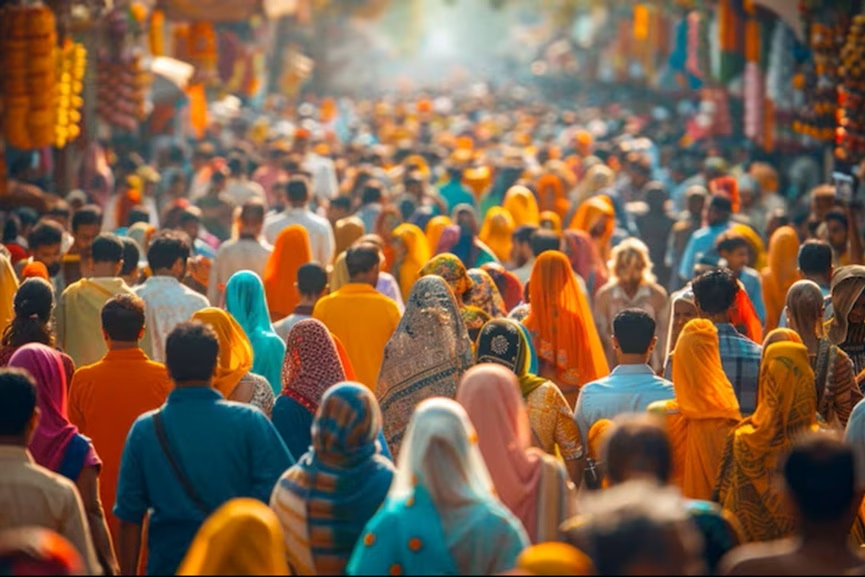
New Delhi: The first phase of Census 2027, covering houselisting operations, will be conducted from April 1 to September 30 this year across all states and Union territories, the Ministry of Home Affairs announced on Wednesday. Each state and UT will carry out the exercise over a 30-day period specified locally.
The government has also introduced an option for self-enumeration, which can be completed within 15 days immediately before the start of the official houselisting period.
Originally scheduled for 2021, the decennial census was postponed due to the COVID-19 pandemic. The 2027 exercise will be conducted in two phases: houselisting and housing census from April to September 2026, followed by population enumeration in February 2027.
The houselisting and housing census will systematically document all structures, houses, and households across the country to prepare an accurate framework for the population enumeration phase.
Registrar General of India and Census Commissioner Mrityunjay Kumar Narayan said the census will be the first fully digital exercise, with around 30 lakh enumerators collecting data via mobile applications compatible with both Android and iOS platforms.
Notification for the Phase I of Census of India 2027 i.e. Houselisting & Housing Census (HLO) has been issued.
Houselisting operations will be conducted between 1 April 2026 and 30 September 2026 across all States and Union Territories, during a 30-day period specified by each… pic.twitter.com/Z7m9j7IaFL
— Census India 2027 (@CensusIndia2027) January 7, 2026
For the first time since Independence, Census 2027 will also capture caste data during the population enumeration phase. The last comprehensive caste-based census in India was conducted between 1881 and 1931 under British rule. The decision to include caste enumeration was approved by the Cabinet Committee on Political Affairs, chaired by Prime Minister Narendra Modi, on April 30 last year.
According to the 2011 Census, India’s population stood at 1,210.19 million, with 623.72 million males and 586.46 million females, highlighting the scope of the massive enumeration exercise.
The government aims to ensure greater accuracy and efficiency through digital data collection, marking Census 2027 as a significant step in modernising India’s demographic record-keeping.