
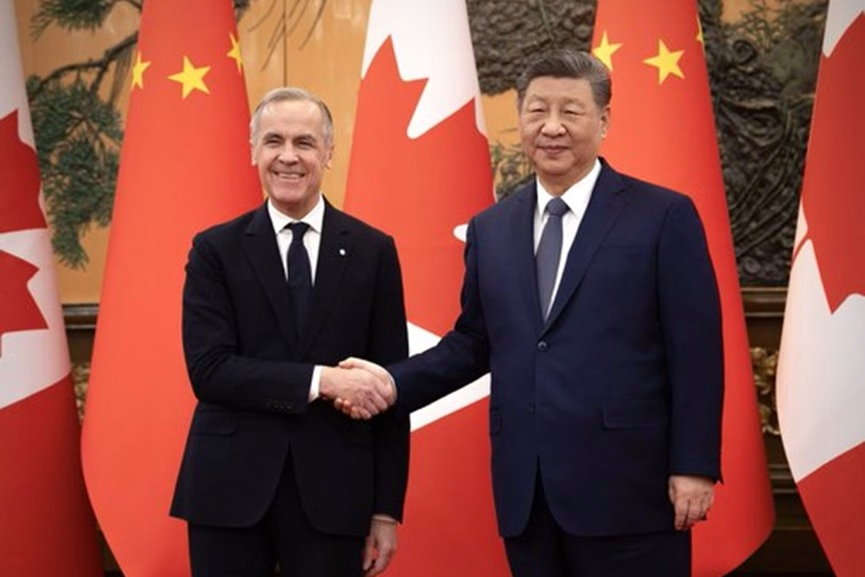
Beijing: Canada and China have taken a significant step toward mending their trade ties with a new agreement that reduces tariffs on electric vehicles and canola. The deal comes during Prime Minister Mark Carney’s visit to Beijing, his first since 2017, and signals a broader effort to rebuild economic and strategic links.
Under the agreement, Canada will allow up to 49,000 Chinese electric vehicles to enter the country at a tariff of 6.1 percent, a steep drop from the 100 percent duty imposed in 2024. That quota is set to rise to 70,000 vehicles over the next five years. Carney said the move will give Canadian consumers more choices and help the country learn from international EV supply chains to grow its own industry.
The deal is a notable departure from US policy. Some American officials criticized it, but President Donald Trump called the agreement a positive step, saying Canada should pursue deals with China whenever possible.
The new trade pact also lifts some of the most damaging tariffs on Canadian agricultural products. China had hit Canada with duties on more than $2.6 billion worth of goods, including canola, lobster, and peas, after Trudeau’s EV tariffs in 2024.
We’re recalibrating Canada’s relationship with China — strategically, pragmatically, and decisively — to the benefit of the people of both our nations. pic.twitter.com/3bGRhvQLsU
— Mark Carney (@MarkJCarney) January 16, 2026
Now, tariffs on canola seed will drop from 84 percent to roughly 15 percent by March 1, with anti-discrimination measures on canola meal, lobsters, crabs, and peas also removed through the end of the year. Analysts estimate the deal could unlock nearly $3 billion in new exports for farmers and fishers.
China confirmed that it would adjust anti-dumping measures on canola and other products in response to Canada lowering EV tariffs. Carney also said China will offer visa-free travel for Canadians, though details are still to be finalized.
The two countries have pledged to restart high-level economic and financial talks and explore cooperation in agriculture, energy, and green technology. Canada plans to double its energy grid in 15 years and is eyeing Chinese investment in offshore wind. The country also aims to ramp up LNG exports to Asia, reaching 50 million tonnes a year by 2030.
Carney described China as a more predictable trading partner than the US, citing recent months of steady engagement. While the deal could shift economic dynamics in the ongoing Sino-US rivalry, experts say Canada is unlikely to pivot away from Washington, given its deep security and intelligence ties. During the visit, Carney also discussed Greenland, reporting alignment of views with Xi Jinping.