

Europe: Millions of Christians around the world, including communities in Eastern Europe, the Middle East, and parts of the Arab world, are celebrating Christmas today.
While most of the world marks December 25 as the birth of Jesus Christ, for about 250 million Orthodox and Coptic Christians, the most important day of the season falls on January 7.
The reason lies in the calendar each church follows. In 1582, Pope Gregory XIII introduced the Gregorian calendar to correct inaccuracies in the older Julian calendar, which had gradually drifted over centuries.
The Julian calendar overestimated the solar year by 11 minutes, causing the seasons to shift over time. While most countries and Christian denominations adopted the Gregorian calendar, many Orthodox and Eastern Christian churches retained the Julian calendar to preserve tradition. Today, the Julian calendar is 13 days behind the Gregorian calendar, making December 25 on the Julian calendar equivalent to January 7 on the modern calendar.
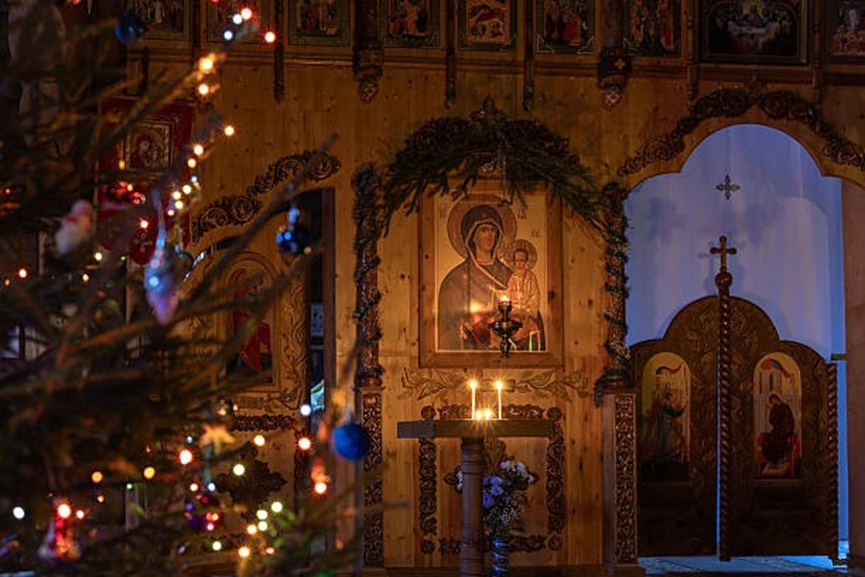
Among the groups celebrating on January 7 are the Russian Orthodox Church, the Serbian and Georgian Orthodox Churches, the Coptic Orthodox Church in Egypt, and the Ethiopian and Eritrean Orthodox Tewahedo Churches.
In Ukraine, Christmas has historically fallen on January 7, though the government officially moved the public holiday to December 25 in 2023, aligning with Western traditions. Some countries, such as Belarus and Moldova, observe both December 25 and January 7 to accommodate multiple Christian communities.
The tradition of marking the New Year on January 1 predates Christianity. The Romans established this date in 153 BC to signify the start of a new political term, and Julius Caesar retained it during his calendar reform in 46 BC. The date of Jesus’s birth is not precisely known. December 25 was chosen by early Christians based on the belief that Jesus was conceived on March 25, the Feast of the Annunciation, making his birth nine months later.
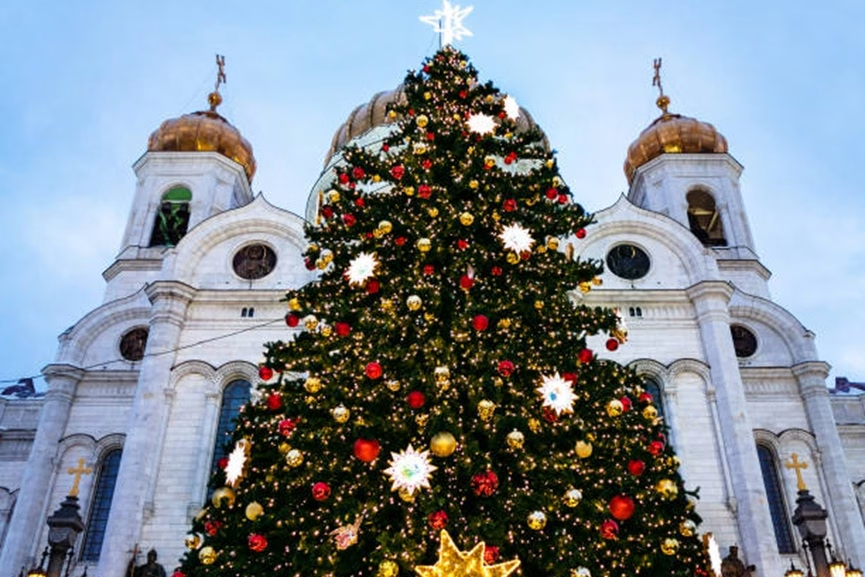
Different calendars are used worldwide to track time. Solar calendars, like the Gregorian, Kurdish, and Persian calendars, follow the Sun and divide the year into 12 months. Lunar calendars, such as the Islamic calendar, track the Moon and have 12 months totaling about 354 days, causing the Lunar New Year to shift each year. Lunisolar calendars, used in Jewish, Hindu, Sikh, Buddhist, and Chinese traditions, combine solar and lunar cycles to keep months and seasons aligned.
The celebration of Christmas on two different dates reflects centuries of history, theology, and astronomy. While the dates differ, the spirit of the holiday, honouring the birth of Jesus, remains the same for Christians around the world.