

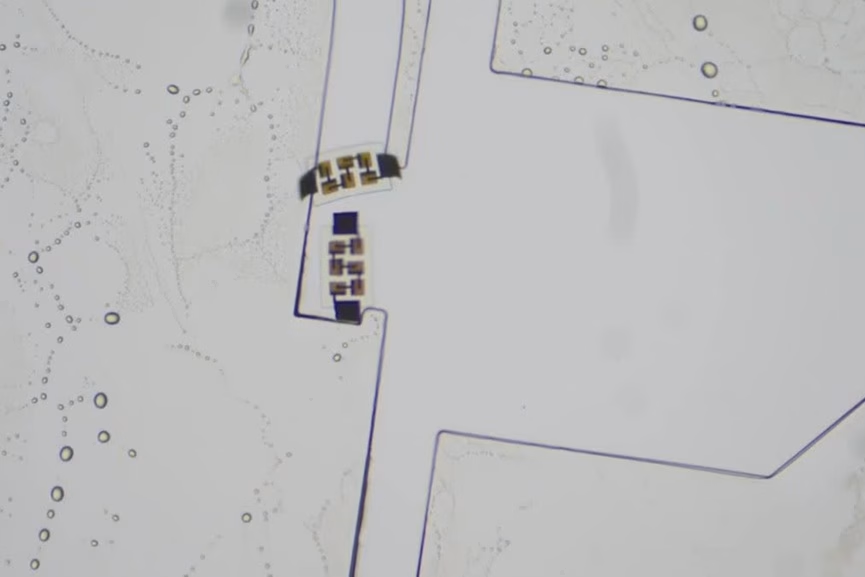
US: Researchers in the United States have unveiled microscopic swimming robots so small they are barely visible to the naked eye, marking a major step forward in robotics and biomedical science.
Developed jointly by teams at the University of Pennsylvania and the University of Michigan, the robots measure just 200 by 300 by 50 micrometres, smaller than a grain of salt. Despite their size, they are capable of monitoring the health of individual cells and responding to their surroundings on their own.
The robots move through liquid in a way that resembles swimming, but without any moving parts. Instead of flexing or paddling like fish, they generate tiny electrical fields that push nearby ions in the surrounding fluid. Those ions, in turn, nudge water molecules, propelling the robot forward in line with Newton’s third law of motion. By precisely adjusting these electrical fields, the robots can follow complex paths and even move in coordinated groups.
Each robot can travel at a speed of about one body length per second, roughly 300 micrometres per second. Built-in sensors allow them to detect temperature changes with remarkable accuracy, down to a third of a degree Celsius. This sensitivity enables the robots to move toward warmer areas, a capability that could be used to assess the health of individual cells.
One of the key breakthroughs lies in their durability and power supply. Because the robots have no moving components, they are highly robust. They are also energy efficient, able to operate for months at a time using power drawn from light. Even the glow of a simple LED is enough to keep them running.
Making the robots fully autonomous required fitting them with a tiny computer, sensors, and a power source, all within an extremely limited space. Researchers at the University of Michigan addressed this challenge by designing ultra-low-voltage electronic circuits that reduced power consumption by more than a thousand times.
Working closely with the Pennsylvania team, they managed to squeeze a processor and memory onto the robot, leaving most of the surface area for miniature solar panels.
The result is what researchers describe as the first microscopic robot that can sense its environment, make decisions, and act independently using an onboard computer. The robots are programmed using pulses of light, which also serve as their power source. Each robot carries a unique address, allowing scientists to upload different instructions to individual units within the same group.
Looking ahead, the research team says future versions could store more advanced programs, move faster, carry additional sensors, and operate in tougher environments. Such improvements could open the door to customised robots designed for tasks ranging from medical diagnostics to the construction of tiny devices at the microscale.