
Florida: NASA has announced that its highly anticipated Artemis 2 mission will finally launch on April 1, a date that has led to widespread skepticism online due to its coincidence with April Fool’s Day. The mission will mark humanity’s return to the Moon after more than 50 years, with the Orion spacecraft set to orbit the lunar surface during a 10-day journey.
The launch has been repeatedly delayed. Initially scheduled for February 6, Artemis 2 faced setbacks, including hydrogen leaks and helium blockages in its Space Launch System (SLS) rocket.
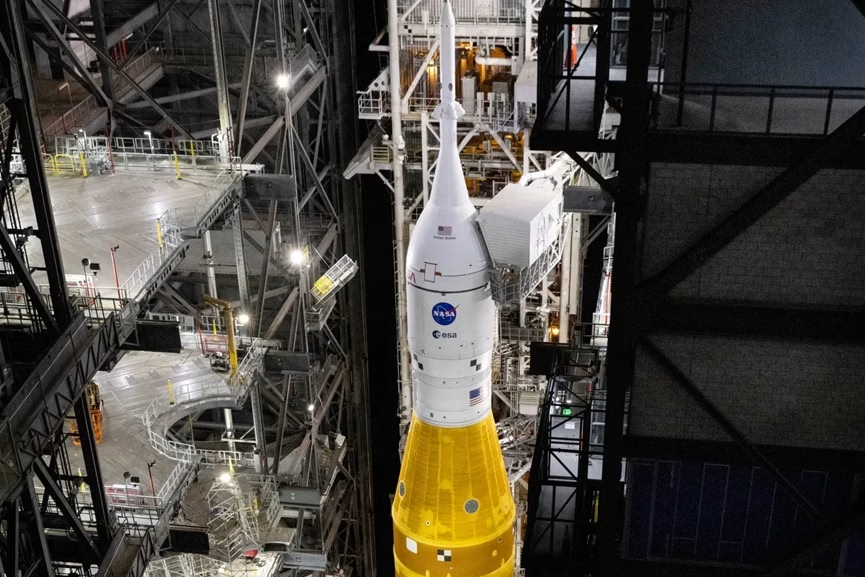
Preparations included a ‘wet rehearsal’ on February 2, which was postponed due to cold weather. A second wet rehearsal on February 19 was largely successful, but a helium flow issue in the rocket’s upper stage required further repairs at the Vehicle Assembly Building (VAB).
Despite the delays, NASA confirmed April 1 as the target date. Acting Associate Administrator Lori Glaze said that, “The next time we tank the vehicle will be when we’re attempting to launch. I am comfortable, and the agency is comfortable with targeting April 1 as our first opportunity.”
NASA teams have polled ‘go’ to proceed toward Artemis II’s launch around the Moon.
We’re targeting March 19 to roll the rocket out to the launchpad at @NASAKennedy in advance of a launch attempt on April 1, pending completion of work at the pad: https://t.co/B58YibEjYI pic.twitter.com/vSVV6wx5No
— NASA (@NASA) March 12, 2026
The agency has also announced a six-day launch window in early April, with an alternative window on April 30 if needed. The choice of date has amused and confused social media users. Some joked that a successful launch on April 1 would be mistaken for an April Fool’s prank, while others highlighted the historic nature of the mission.
Artemis 2 is already running two years behind schedule. During Artemis 1, Orion’s heat shield revealed vulnerabilities, prompting NASA to tighten deadlines for upcoming missions. The astronauts for Artemis 2—Reid Wiseman, Victor Glover, Christina Koch, and Canadian astronaut Jeremy Hansen—are preparing to make history.
NASA has also adjusted its plans for future missions. Artemis 3 will no longer land on the Moon but will instead test communications, propulsion systems, and xEVA suits in orbit. The next human moon landing is now scheduled for 2028 with Artemis 4.