
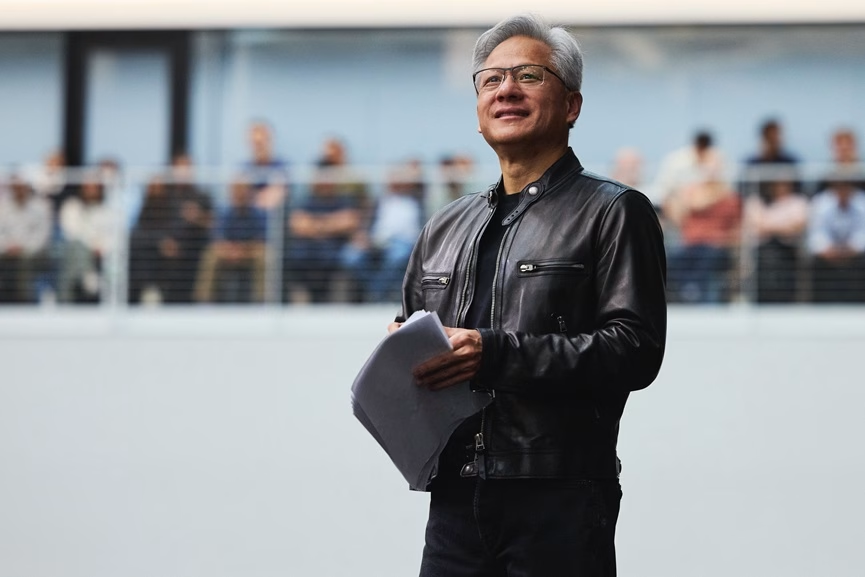
US: Donald Trump has authorised Nvidia to resume selling some of its most advanced computer chips to China, reversing earlier restrictions and delivering a significant victory for the chipmaker and its chief executive, Jensen Huang.
The move marks one of the most notable shifts in Washington’s tech policy since the start of Trump’s presidency. Before the announcement, Nvidia had been barred from sending high-end processors to China because of national security concerns. The restrictions cut off a major market and forced the company to design weaker models that still ended up being blocked earlier this year.
Trump said he informed China’s President Xi Jinping that the United States would allow Nvidia to ship its H200 processors to approved customers in China and other countries. The president said the Commerce Department is now finalising the conditions. He also signalled that similar permissions could be extended to other chipmakers, including AMD and Intel.
In a notable twist, Trump said the US government would receive 25 percent of the revenue from these sales, an increase from an earlier 15 percent arrangement negotiated with Nvidia. The president has repeatedly pushed for the government to take direct financial stakes in private sector deals, including a proposed 10 percent ownership share in Intel announced in August. Several lawmakers have questioned the legality of such plans.
Democratic senators Elizabeth Warren of Massachusetts and Andy Kim of New Jersey recently urged Commerce Secretary Howard Lutnick to stop any approval. Their letter warned that advanced US chips could strengthen China’s surveillance systems, censorship tools, and military capabilities. Warren also called publicly for Huang to testify before Congress.
Huang has maintained close ties with the White House since Trump took office. He has attended multiple meetings on technology policy, held discussions with the president as recently as last week, and was invited to a state dinner for Saudi Crown Prince Mohammed bin Salman. The Nvidia chief has pledged to invest $500 billion in US-based computing infrastructure over the next four years.
The decision opens the door for Nvidia to rebuild its presence in China, a market that once accounted for 95 percent of its local sales before restrictions cut the figure to zero. The company is currently valued at around 4.5 trillion dollars, and renewed access to the world’s second-largest economy could generate billions in fresh revenue.
Nvidia welcomed the announcement, saying the decision to allow exports of the H200 processor to customers vetted by the Commerce Department supports US manufacturing and jobs.
China responded cautiously on Tuesday, saying cooperation between the two countries can lead to mutual benefit. Analysts quoted in state media argued that years of US limits had helped China accelerate efforts to develop its own semiconductor industry.
Huang, who has travelled frequently between Washington and Beijing in recent years, has long argued that shutting American firms out of China was a strategic error. With the new approval in place, Nvidia is now positioned to regain ground in a market it once dominated, while the White House pursues a broader reset of its technology strategy in Asia.