
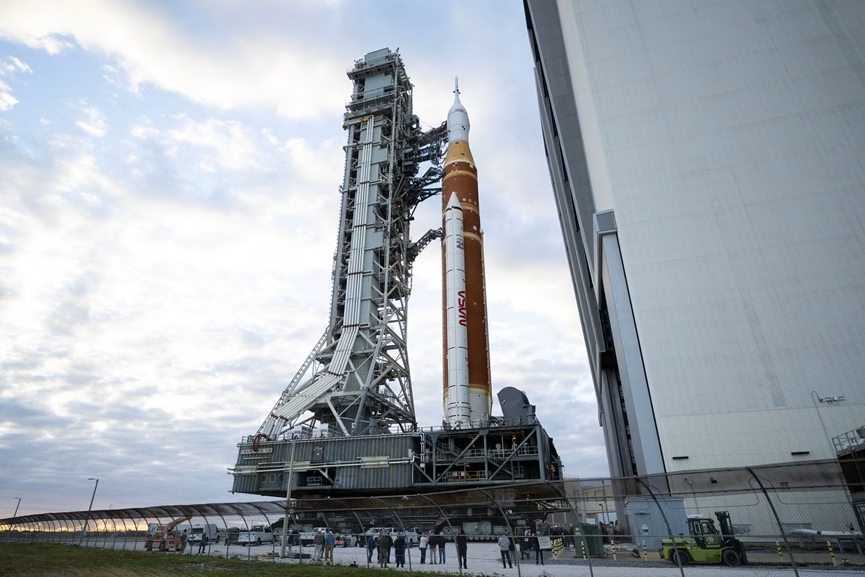
Florida: More than five decades after Apollo 17 marked humanity’s last journey to the Moon, NASA is set to take a major step forward in human spaceflight with the Artemis II mission, scheduled for launch on February 6.
The mission will carry four astronauts on a 10-day voyage around the Moon, marking the first crewed lunar mission since 1972. The crew includes NASA commander Reid Wiseman, pilot Victor Glover, mission specialist Christina Koch, and Canadian Space Agency astronaut Jeremy Hansen.
In preparation, NASA has moved the Orion spacecraft and the Space Launch System rocket to the launch pad at Cape Canaveral in Florida. Final checks and testing are now underway ahead of the historic flight.
NASA officials say Artemis II will push humans farther from Earth than ever before and provide critical data needed for future lunar landings. The mission is seen as a key step toward establishing a sustained human presence on the Moon and eventually paving the way for crewed missions to Mars.
We’re heading to the Moon.
The launch window opens as early as Feb. 6 for our crewed @NASAArtemis mission. Throughout the journey, we’ll bring you live coverage on NASA+: https://t.co/XjTc1fTzOv pic.twitter.com/bkDAflxC8D
— NASA (@NASA) January 19, 2026
Testing the Path Back to the Moon
Unlike future missions, Artemis II will not land on the lunar surface. Instead, it will focus on thoroughly testing Orion and NASA’s deep-space systems in real flight conditions with astronauts on board.
After lifting off from the Kennedy Space Center, the crew will first orbit Earth to verify life-support, navigation, and communication systems. While still close to home, astronauts will closely monitor air, water, and temperature controls essential for deep-space travel.
The spacecraft will then use the Moon’s gravity to perform a trans-lunar injection, sending Orion on a four-day journey around the far side of the Moon. The flight path will trace a figure-eight trajectory, taking the crew more than 230,000 miles from Earth at its farthest point.
The mission will follow a free-return route, allowing the spacecraft to naturally loop back toward Earth without additional engine burns. The journey will end with a high-speed reentry through Earth’s atmosphere and a splashdown in the Pacific Ocean.

Building Toward Artemis III
Artemis II builds on the success of Artemis I, an uncrewed test flight completed in 2022 that validated Orion and the Space Launch System. The upcoming mission will provide crucial experience and confidence ahead of Artemis III, planned for 2027, when astronauts are expected to land on the Moon’s south pole for the first time.
In the days ahead, NASA engineers will conduct a wet dress rehearsal, rehearsing fueling procedures and countdown operations. The rocket will be loaded with super-cold propellants, and teams will practice safely draining them, a critical step before any crewed launch.