
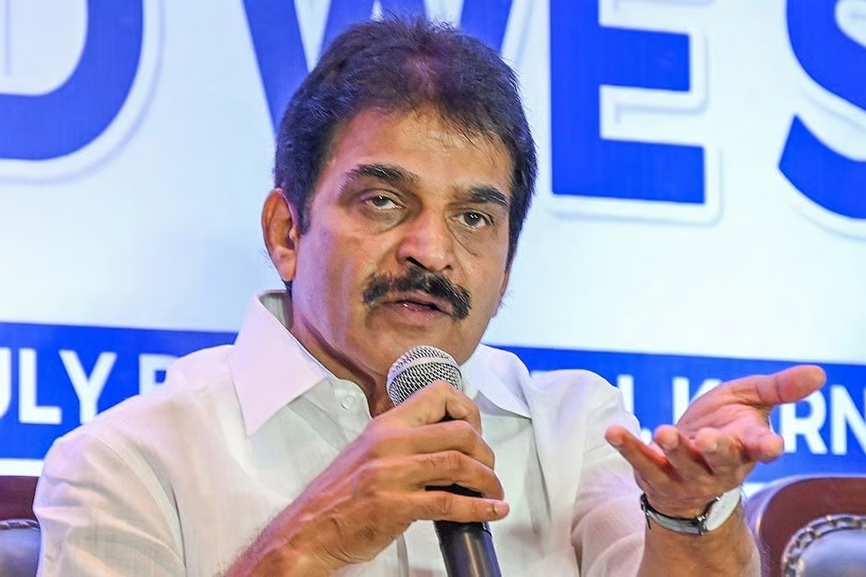
Kerala: Political discussions surrounding the possibility of KC Venugopal emerging as the next Chief Minister of Kerala have now entered a decisive phase.
If such a transition materializes, the resulting political, financial, administrative, and organizational implications could be substantial. This article attempts to evaluate those realities in detail.
Under the Constitution of India, a Member of Parliament can indeed be sworn in directly as Chief Minister. However, such an arrangement is only temporary. Within six months, the individual must become a member of the Kerala Legislative Assembly.
In practical terms, if KC Venugopal assumes office as Chief Minister while continuing as MP from Alappuzha, the United Democratic Front would first need to vacate a “safe” Assembly seat by persuading an existing MLA to resign.
Venugopal would then have to contest and win that by-election within the constitutional deadline. Failure to do so would compel him to step down as Chief Minister.
Even if he succeeds in entering the Assembly, another challenge immediately follows. He would then have to resign from the Lok Sabha, triggering a parliamentary by-election in Alappuzha. In the present political climate, even a supposedly safe constituency may not guarantee victory.
A significant section of voters, including sections traditionally aligned with the UDF, could interpret the entire process as a politically engineered power struggle rather than a democratic transition.
If Venugopal were to lose the Assembly by-election and consequently resign as Chief Minister, the political repercussions for Congress, from Kerala to the national level, could become severe and deeply embarrassing.
Yet even a successful Assembly victory would not eliminate risk. The by-election in the Alappuzha Lok Sabha constituency would itself become unpredictable, with Congress facing no certainty of retaining the seat.
In the 2024 Lok Sabha election, KC Venugopal secured 404,560 votes in Alappuzha. A. M. Ariff of the Left Democratic Front received 341,047 votes, while Sobha Surendran of the NDA secured 299,648 votes. Venugopal’s winning margin stood at 63,513 votes.
Critics argue that such a margin is not politically invulnerable, particularly in an atmosphere where voters are closely watching what may be perceived as an internal struggle for the Chief Minister’s office. Beyond the electoral risks, the financial burden associated with this political transition would also be significant.
A Lok Sabha by-election requires major public expenditure from taxpayer funds for security deployment, EVM logistics, polling staff, transport, observers, and election administration.
Estimates suggest these expenses alone could exceed ₹10 crore. In addition, campaign expenditure involving rallies, advertisements, banners, vehicles, and public mobilization would place further financial pressure on political parties and their supporters.
The Assembly by-election required to induct Venugopal into the Kerala Legislature would create another layer of expenditure.
Government spending for a single Assembly by-election can range from ₹2 crore to ₹5 crore, excluding campaign spending by candidates and parties. Under current estimates, candidates themselves may need to spend up to ₹40 lakh during the campaign process.
Critics also point out that the public and party resources already invested in electing Venugopal to Parliament in 2024 would effectively become redundant within a short period.
At the same time, Congress may also have to confront serious internal contradictions, especially since strong objections against sitting MPs contesting Assembly elections, raised earlier by senior leaders, including K. Sudhakaran, still remain politically relevant within the party.
Critics argue that if the party alters this position now, the All India Congress Committee could face similar questions and pressure in other states as well.
In short, there is no certainty that Venugopal would win an Assembly by-election. Even if he does, there is no guarantee Congress would retain the Alappuzha Lok Sabha seat after his resignation. If either process fails, the resulting political instability and reputational damage could become far-reaching.
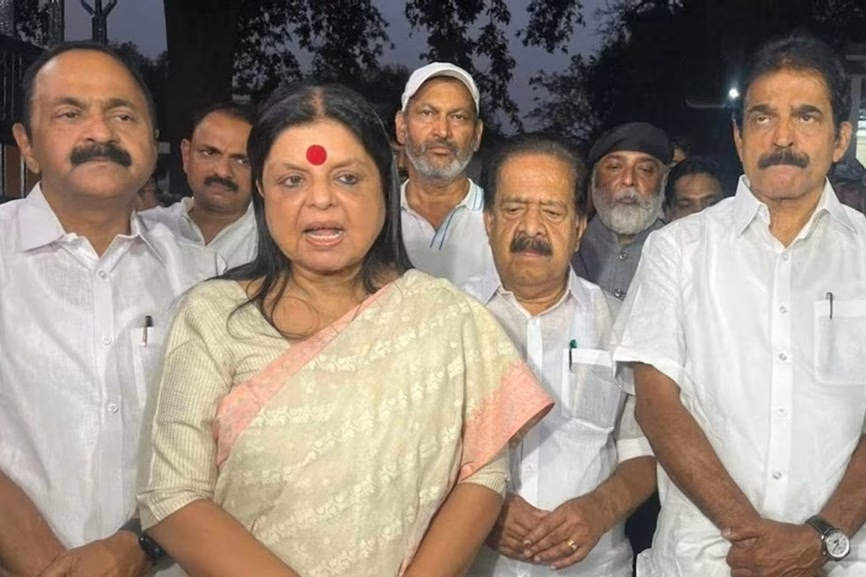
Kerala and KC Venugopal
There is little dispute regarding KC Venugopal’s stature within the National Congress organization. He is regarded as an influential and credible figure in the party’s national structure. However, Kerala’s political environment today is intensely emotional, socially sensitive, and deeply rooted in grassroots engagement.
Critics argue that the state currently requires a leader with strong social connections, emotional resonance, and organic political grounding within Kerala society. It is in this context that questions emerge regarding Venugopal’s suitability.
Unlike leaders who rose continuously through Kerala’s active grassroots political environment, Venugopal’s rise in recent years has been largely associated with his national organizational influence within Congress.
As a result, political observers question whether a leader who has spent the better part of the last decade immersed in national politics can effectively manage Kerala’s increasingly complex social and political realities.
Kerala is currently facing one of the most serious financial crises in its modern history. Between 2016 and 2026 alone, the state’s public debt reportedly increased by approximately ₹3.93 lakh crore.
This means the state could face an average annual repayment burden of nearly ₹28,572 crore, including both principal and interest obligations.
At the same time, nearly 71 percent of Kerala’s total expenditure is reportedly being consumed by salaries, pensions, and interest liabilities. To understand the scale of this crisis, one must recognize that Kerala’s total public debt from 1956 to 2016, across six decades, stood at around ₹1.57 lakh crore. In just the following ten years, that figure is estimated to have surged to nearly ₹5.5 lakh crore.
In such circumstances, any future Chief Minister may be forced to take deeply unpopular decisions involving expenditure controls, revenue reforms, taxation measures, or restructuring of welfare commitments. Critics question whether a nationally positioned leader like KC Venugopal, who lacks strong mass emotional connectivity within Kerala, would be able to withstand such public pressure.
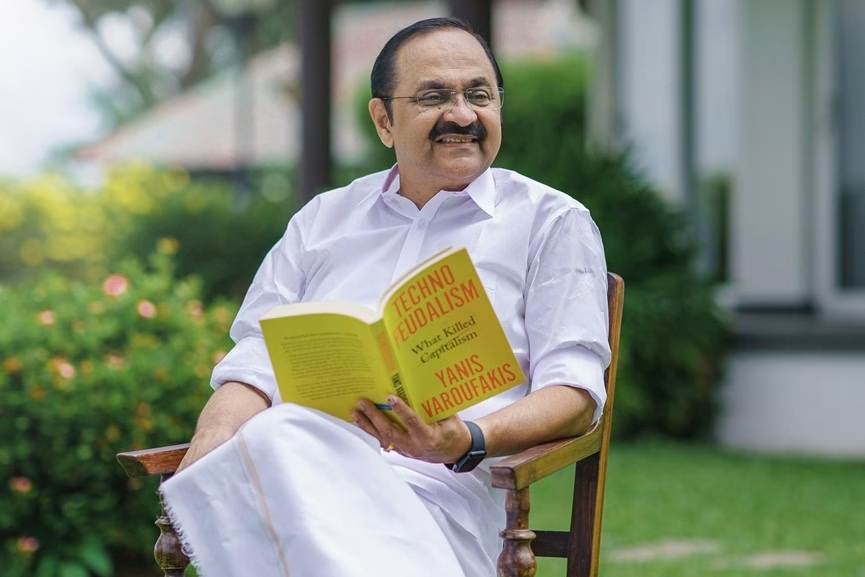
Politics and KC Venugopal
Born on February 4, 1963, in Kadannappally village in Kerala’s Kannur district to Kunjikrishnan Nambiar and Janakiyamma, the 63-year-old KC Venugopal first rose to statewide political prominence after becoming Kerala State President of the Kerala Students’ Union in 1987.
A postgraduate in mathematics and a law graduate, he later served for eight years, from 1992 to 2000, as President of the Kerala Youth Congress.
Venugopal was first elected to the Kerala Legislative Assembly from Alappuzha in 1996. He was subsequently re-elected in 2001 and 2006. During the Oommen Chandy ministry between 2004 and 2006, he handled the Tourism and Devaswom portfolios.
He later served as a member of the Kerala Pradesh Congress Committee Executive. In the 2009 Lok Sabha election, he defeated sitting MP Dr. K. S. Manoj to enter Parliament for the first time. Between 2011 and 2014, he served as Union Minister of State.
In April 2017, Venugopal was appointed General Secretary of the All India Congress Committee. He retained strong influence within the national organizational structure of the Congress party thereafter.
He was re-elected to the Lok Sabha from Alappuzha in 2014. In 2019, despite reluctance to contest another Lok Sabha election, Congress selected him as a Rajya Sabha member from Rajasthan. In 2024, he returned to electoral politics in Kerala, contested from Alappuzha again, and won.
Today, in addition to serving as MP and Congress National General Secretary, he also holds another major constitutional responsibility at the national level.
Since August 2024, KC Venugopal has served as Chairman of Parliament’s Public Accounts Committee, one of India’s most important parliamentary oversight bodies responsible for examining government revenue and expenditure.
The appointment, made by the Speaker of the Lok Sabha, carries considerable institutional responsibility. If Venugopal becomes Chief Minister, he would also have to relinquish this position.
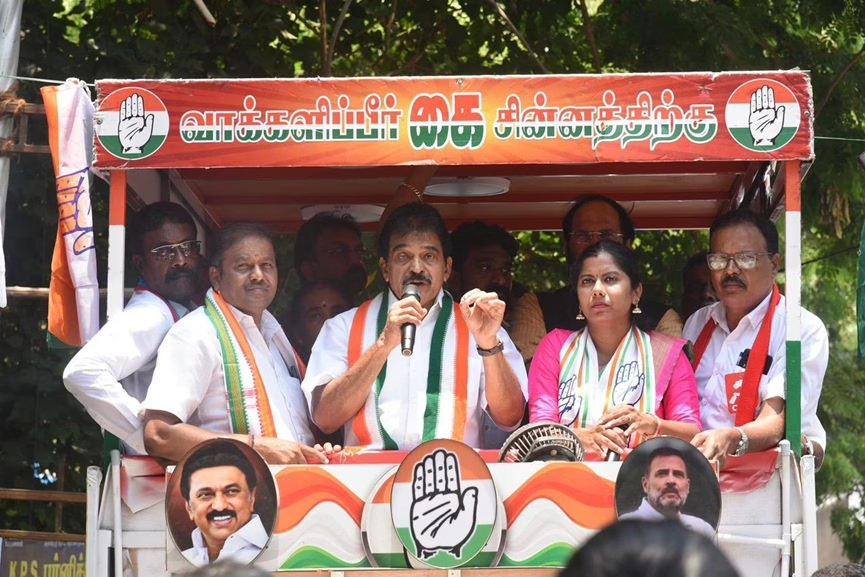
Why This Uncertainty Exists
Critics allege that Venugopal’s decision in 2024 to resign from the Rajya Sabha, despite having nearly two years remaining in his term, reflected a larger political ambition.
According to this argument, Congress leadership may have expected the BJP-led alliance to lose power at the Centre, thereby opening the possibility for Venugopal to become a Union Minister in a future coalition government.
Instead, he contested the 2024 Lok Sabha election from Alappuzha and won by a margin of 63,513 votes. However, Congress failed to secure power at the national level.
Critics further point out that his resignation from the Rajya Sabha created another political consequence. The vacant Rajasthan Rajya Sabha seat was later won uncontested by BJP leader Ravneet Singh Bittu, leaving the Congress without representation there.
Now, with more than three years remaining in his current Lok Sabha term and serving simultaneously as Congress National General Secretary and Chairman of the Public Accounts Committee, critics question whether seeking the Kerala Chief Ministership would expose both the party and voters to unnecessary instability.
They also question the contradiction within Congress itself. If the party leadership had earlier maintained that MPs should not contest Assembly elections, how would the same leadership now justify facilitating such a transition for Venugopal?
Another question raised by independent observers is this: when Congress already has leaders within Kerala who have won Assembly elections and possess direct state-level administrative legitimacy, why should a national-level organizational leader be inserted into the Chief Ministerial position?
Would such a move, critics ask, ultimately raise broader questions about Rahul Gandhi’s leadership strategy? Could it deepen internal dissatisfaction and further strain Congress’s national reputation? These are among the questions increasingly being debated in political circles.
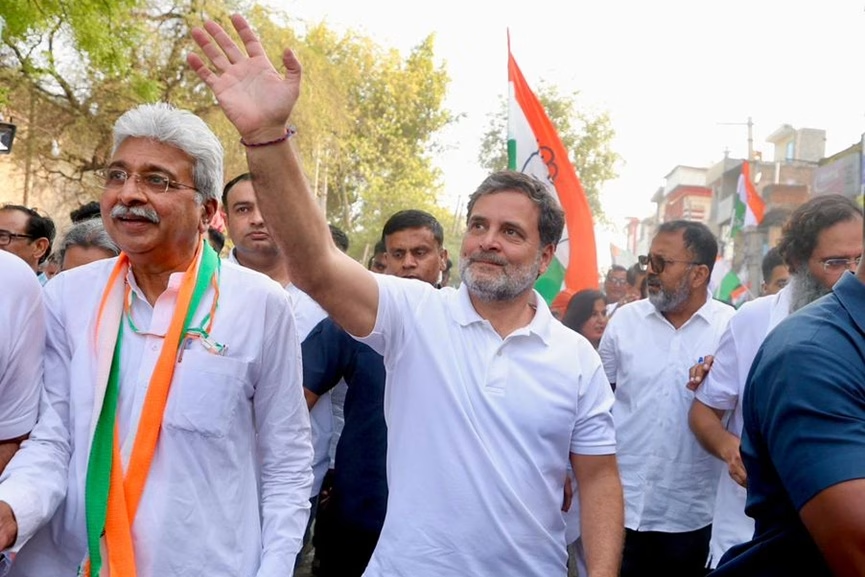
The Challenge Ahead Is Significant
Since becoming more deeply involved in national politics after 2014, critics argue that KC Venugopal has gradually moved away from Kerala’s day-to-day political realities and grassroots public discourse.
While he continues to maintain personal influence and organizational strength in Alappuzha, observers question whether he possesses a comparable emotional connection with first-time voters, digitally driven younger demographics, and the politically evolving new generation that has emerged over the last decade.
At present, a significant section of political discussion on social media, particularly among younger audiences, frames Venugopal less as a mass leader and more as a contender entering an already active leadership contest.
For that reason, critics believe that introducing Venugopal as a widely accepted Chief Ministerial face among younger voters who have politically aligned themselves with figures such as V. D. Satheesan could prove extraordinarily difficult.
In conclusion, observers warn that the Congress party may be underestimating the cumulative impact of several interconnected realities: its earlier position against MPs contesting Assembly elections, the financial and political burden of multiple by-elections, the unpredictability of voter response, and the risks associated with leadership transition at a time of severe fiscal stress in Kerala.
If mishandled, critics argue, such a political gamble could ultimately weaken Congress further at both the state and national levels.