
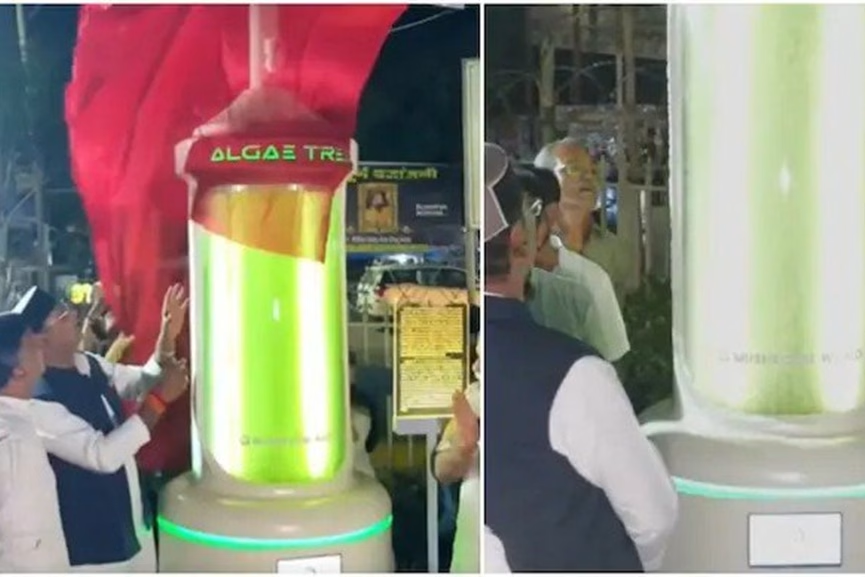
Madhya Pradesh: In a first-of-its-kind step towards cleaner urban living, the city of Bhopal has introduced India’s first ‘Algae Tree’-an innovative carbon-capturing system designed to improve air quality while tackling rising pollution levels and climate concerns.
Installed at Swami Vivekananda Park under the city’s Smart City initiative, the futuristic structure has quickly attracted attention across social media, with videos and photographs of the installation widely shared online.
Many users praised the project as a promising urban solution at a time when Indian cities are facing extreme heat, shrinking green cover, and worsening air pollution.
Developed by Mushroom World Group, the ‘Algae Tree’ works through a microalgae-based system that absorbs carbon dioxide from the surrounding air and releases oxygen back into the atmosphere.
According to the company, a single unit can capture nearly 1.5 tonnes of carbon dioxide annually—roughly equivalent to the carbon absorption capacity of around 25 mature trees.
India’s first Algae Tree that converts carbon dioxide into oxygen, equal to 25 trees.
It also has solar panels on top and is installed in Bhopal’s Swami Vivekananda Park.
Credit: Team Update Bus Bhopal, ViaWeb pic.twitter.com/4nBbP5B7qg
— Pareekh Jain (@pareekhjain) May 10, 2026
The structure also features solar panels mounted on top, allowing part of its operations to run on renewable energy. The company said the project took nearly two years to complete and involved the work of more than 50 researchers, engineers, and technical experts.
Supporters of the initiative believe the technology could offer a practical alternative for densely populated urban spaces where large-scale tree plantations are difficult to implement.
With limited land availability in many cities, compact carbon-capturing systems such as the ‘Algae Tree’ may become an important addition to future climate action strategies.
The project arrives at a crucial time as cities across India continue to search for sustainable ways to reduce carbon emissions and improve public health.
Officials and environmental advocates say innovations like these could play a meaningful role in building greener and more climate-resilient urban centers.