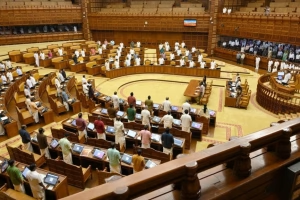

New Delhi: India is moving toward one of the most consequential political reforms in decades, as the government prepares a sweeping overhaul of parliamentary representation alongside a long-promised quota for women.
At the center of the plan is the Nari Shakti Vandan Adhiniyam, which proposes reserving one-third of seats in Parliament and state assemblies for women. Currently, women account for only about 14 percent of members in the 543-seat Lok Sabha, well below global averages.
The reform, however, is closely tied to a broader and more contentious exercise — the redrawing of constituencies based on population data. The government has indicated that this could significantly expand the lower house, potentially increasing its strength to around 850 seats.
Reform Meets Resistance
Prime Minister Narendra Modi has framed the move as a historic milestone, describing it as one of the most significant decisions of the century. He has argued that the measure reflects a long-overdue commitment to women’s empowerment and has broad political backing.
But opposition parties are pushing back, not against the quota itself but against the way it is being implemented.
Leaders argue that linking women’s reservation to delimitation—the redrawing of electoral boundaries—turns a widely supported reform into a politically sensitive restructuring of representation. They have also criticized the timing, with the proposal being advanced during an election cycle.
A proud and historic step!
This Bill ensures 33% reservation for women, something long awaited.
I urge all parties to support it wholeheartedly & not spread confusion on delimitation.
Let us not let this opportunity slip. pic.twitter.com/GQ8EHugmB2— Kiren Rijiju (@KirenRijiju) April 16, 2026
The Delimitation Debate
India’s Constitution requires seats in Parliament to reflect population changes, with periodic delimitation after each census. The process was last carried out using 1971 census data, after which it was frozen to avoid penalizing states that successfully controlled population growth.
The current proposal signals a shift, with the government planning a fresh delimitation exercise based on 2011 census figures.
This has raised concerns, particularly in southern states such as Tamil Nadu, Kerala, Karnataka, Telangana, and Andhra Pradesh. These regions, which have lower population growth but stronger economic and social indicators, fear losing political weight in Parliament.
Their leaders argue that the proposed changes could reward states with higher population growth while disadvantaging those that have invested in development and family planning.
Tamil Nadu Chief Minister M. K. Stalin has been among the most vocal critics, calling the plan a “historic injustice” and staging protests to highlight the issue.
Experts have also raised concerns about the lack of clarity in the proposal. The jump in Lok Sabha seats to around 850 has not been fully explained, with questions over how the numbers align with population changes over time.
There are also practical challenges in implementing the women’s quota. Deciding which constituencies will be reserved — and how to balance representation for Scheduled Castes and Scheduled Tribes — remains a complex task.
Another point of contention is the reliance on 2011 census data, with critics questioning why the exercise is not being aligned with a new census that is due.
The government maintains that waiting for fresh data would delay both delimitation and women’s reservation well beyond 2029. It has been suggested that seat allocation will follow a proportional model to ensure no state loses representation outright.
Still, skepticism remains. Analysts warn that even without reducing seats, shifts in relative representation could reshape the balance of power between regions, with long-term implications for India’s federal structure.
TRENDING | US–Indonesia Defence Pact Strengthens Strategic Ties in Asia-Pacific