
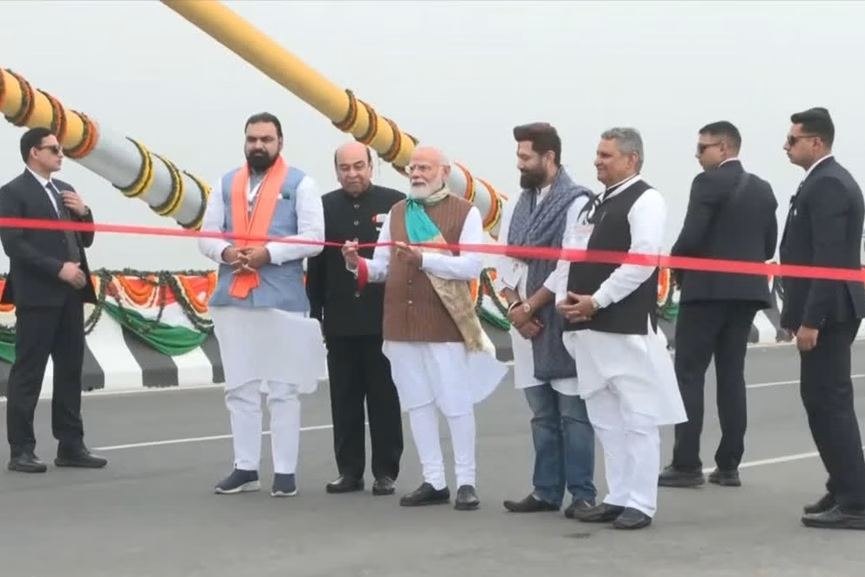
Bihar: Indian Prime Minister Narendra Modi inaugurated the 19.76-km-long Nitish Setu over the Ganga in Bihar, connecting Kachchi Dargah in Patna district with Raghopur and Bidupur in Vaishali district.
The bridge, described as India’s longest river bridge, is expected to improve connectivity between north and south Bihar and reduce travel time for commuters and the movement of agricultural produce.
During his visit to Vaishali, Modi also inaugurated and laid the foundation stones for 227 development projects worth more than Rs 34,000 crore across the state.
Addressing a public gathering in the Jandaha–Rajapakar–Mahua industrial area, the Prime Minister highlighted the NDA government’s poverty alleviation programs and criticized previous Congress and Rashtriya Janata Dal (RJD) governments over their records on poverty and development.
Modi highlights poverty reduction and welfare schemes
Modi said the Congress had used the slogan of Garibi Hatao (remove poverty) for decades without adequately addressing the issue, while claiming that the NDA government had lifted 50 crore people out of poverty in around 12 years.
He attributed the progress to government welfare programs, including free food distribution, housing, healthcare, electricity, drinking water, and sanitation facilities.
The Prime Minister said that the government provides free food grains to 80 crore people and has helped families access permanent housing and free medical treatment. He added that access to basic services had improved living conditions and enabled more people to move out of poverty.
Highlighting Bihar’s contribution, Modi said the state government had implemented several central welfare schemes. He cited the provision of permanent houses to 43 lakh families, approval for another 11 lakh houses in August, and financial assistance to 75 lakh farmers through the PM-KISAN Samman Nidhi scheme. He also said support for self-help groups had helped 50 lakh women become Lakhpati Didis.
The Prime Minister praised former Bihar Chief Minister and Janata Dal (United) president Nitish Kumar for his contribution to the state’s development. He noted that Bihar had chosen a path of development and better governance under Kumar’s leadership.
Modi added that Chief Minister Samrat Choudhary and his government were continuing the work initiated by Kumar.
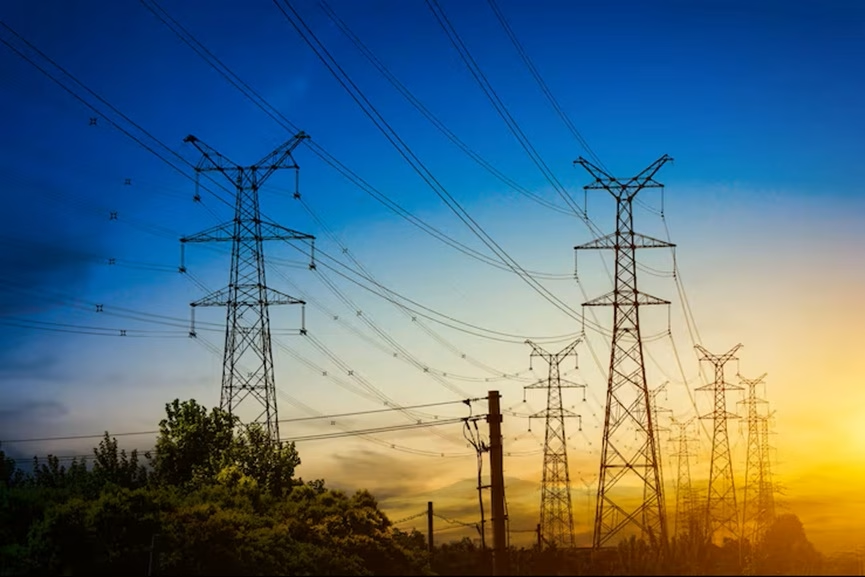
Contrasting the state’s current development priorities with its earlier record, Modi said Bihar had moved from discussions about corruption and crime to investment and action against criminals. He also highlighted the state’s growing role in electricity generation.
Nitish Setu is exceptional!
गंगा नदी पर बने भव्य ‘नीतीश सेतु’ का लोकार्पण किया।
इस शानदार सेतु का अवलोकन करने का भी सुअवसर मिला।
इससे उत्तर और दक्षिण बिहार के बीच आवागमन सुगम होने के साथ ही राज्य के विकास और समृद्धि को नई गति मिलेगी। https://t.co/OXX00qMdmI
— Narendra Modi (@narendramodi) November 21, 2026
Nitish Setu to improve connectivity across Bihar
The newly inaugurated Nitish Setu is an extra-dosed cable-stayed bridge built across the Ganga. Its main bridge section measures 9.76 km, while the total project length, including approach roads on both sides of the river, is 19.76 km.
The bridge connects Kachchi Dargah near Patna with Raghopur and Bidupur in Vaishali district. It links National Highways 22 and 322 and is expected to make travel between north and south Bihar more convenient.
The project was jointly constructed by Larsen and Toubro (L&T) and South Korea’s Daewoo Engineering and Construction Company under the supervision of the Bihar State Road Development Corporation Limited.
During the inauguration, Modi inspected a model of the bridge and walked across the newly opened structure with Chief Minister Samrat Choudhary, Union Minister Chirag Paswan, and Deputy Chief Minister Vijay Kumar Choudhary.
Other infrastructure and development projects
Alongside the bridge, the Prime Minister inaugurated and laid the foundation stones for several infrastructure, energy, housing, healthcare, and urban development projects.
The projects included the second unit of the Buxar thermal power project, the handover of 26,917 permanent houses to beneficiaries, 106 health centers, drinking water supply projects in 11 cities, and the introduction of 100 electric buses. Agricultural markets in Patna and Gaya were also among the projects inaugurated.
Modi additionally laid the foundation stone for a waste-to-energy plant on the outskirts of Patna. The facility is designed to process more than 1,600 tonnes of waste daily from 13 municipal bodies within a 45-km radius and generate 15 MW of electricity.
The proposed facility will also include a 100-tonne-capacity biomethane plant and a compost plant with a capacity of 700 tonnes.
Following the Bihar program, Modi departed for Lucknow, Uttar Pradesh, where he was scheduled to attend a convocation ceremony for industrial training institutes (ITIs), National Skill Training Institutes (NSTIs), and institutes for training of trainers.