
Based on reports from the International Atomic Energy Agency, established on July 29, 1957 with the support of the United Nations, as well as other assessments, Iran’s nuclear activities are viewed as not progressing in a credible or fully transparent direction.
This, combined with the assessment that such developments could be directed against Israel, which Iran has declared as a religious, ideological, and political adversary, forms the core of the current war-like situation.
Secondly, the operational patterns of groups such as Hezbollah, Hamas, and the Houthis, which are supported by Iran through funding, weapons, and training, have further intensified regional tensions.
Thirdly, strong statements by Iranian leaders, including claims that Israel will not exist within twenty-five years and that the Zionist regime must be eliminated, have added to the escalation and contributed to a war-like atmosphere.
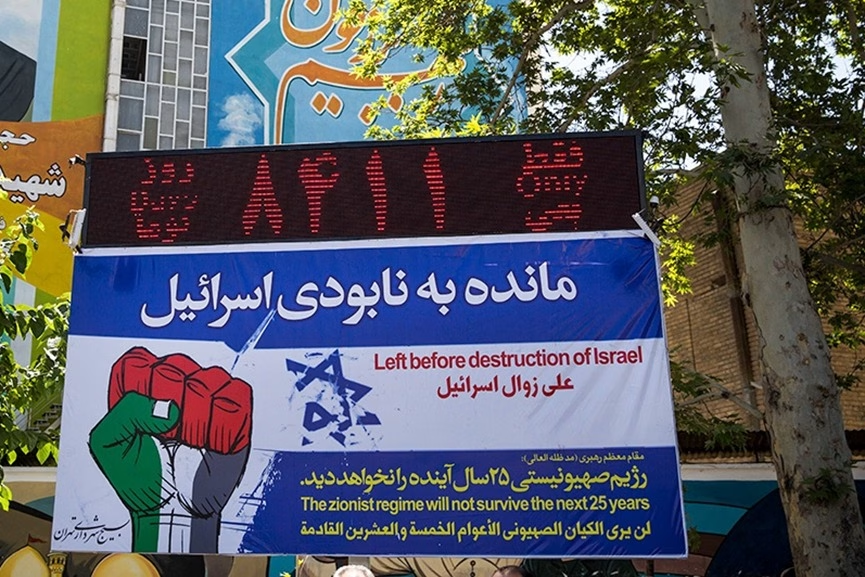
Fourthly, in 2017, a countdown clock with a public banner was installed at Palestine Square in Tehran, reflecting a statement by Ali Khamenei that Israel would not exist within twenty-five years. This highly visible display reinforced earlier rhetoric and signaled a sustained political message.
Taken together, these developments have sharply escalated tensions, making the current conflict-like situation increasingly difficult for both Israel and the United States to ignore or avoid.
This countdown clock, while giving a message to the Iranian people that ‘we are fighting for a great cause,’ is also evaluated by Israel as a psychological movement that turns the entire youth of Iran into a weapon against Israel, described as a “demonic country.” This evaluation is supported by the statement of Iran’s Parliament Speaker Mohammad Bagher Ghalibaf that “if there is a US ground attack, around seven million Iranians are ready to take up arms to defend Iran.”
There are no directly comparable historical instances in which one country has declared that another would be eliminated within the next 25 years and installed a public banner with a countdown clock.
On May 31, 2025, the International Atomic Energy Agency stated in its report ‘Verification and Monitoring in the Islamic Republic of Iran in Light of United Nations Security Council Resolution 2231 (2015)’ that Iran had enriched uranium up to 60%. This indicates that Iran has moved significantly closer to the technical threshold associated with nuclear weapons capability, a development that has raised serious global concern.
In particular, the fact that a state that has repeatedly articulated opposition to Israel in both political and ideological terms is reaching such a level of enrichment is widely viewed as a dangerous and destabilizing development, while the officially acknowledged April 2024 attack involving more than 300 drones and missiles against Israel has taken provocation to its peak.
In addition, not fully rejecting the ship attacks in the Red Sea carried out by the Iran-backed Zaidi Shia armed movement Houthis operating in Yemen, not taking a position against the Houthis, not rejecting Hamas, which operates with Iran’s support and often creates attacks in Israel and its borders, and supporting Lebanon-based Hezbollah, which organizes armed attacks against Israel, have all created a situation in which Israel considers that the time has come for a fight for self-defense and survival.
US Claims Lack Credibility
Since the Iraq War, one of the most controversial conflicts in modern history, in which hundreds of thousands of civilians were killed, the gap between the official reasons and the ground reality has become evident, and the reality is that US assessments and reports are no longer sufficient to convince the world.
In particular, as suspicions continue around agendas such as oil interests, Middle East influence, and regime change strategies, the United States has lost its credibility to an extent where it is unable to convince global nations, including Muslim-majority countries, and this credibility effectively ended with the Iraq War.
The justifications presented to the world for the Iraq War, including the existence of Weapons of Mass Destruction (WMD), claims that Saddam Hussein supported terrorist groups, and the narrative of bringing democracy to the Middle East, were later understood to have no connection with reality.
The credibility lost at that stage further declined during the second presidency of Donald Trump, leading to a situation where the United States is seen as a ‘clown state’ among sections of the global youth population. It is highly likely that the United States will continue to find it extremely difficult to regain the world’s trust, as it remains under deep suspicion.
In particular, according to a humanitarian crisis report released on March 31, 2026, by UNICEF, more than 340 children have been killed in Iran so far in US-Israel attacks, and among them, 168 children were killed on the first day of the war in a missile attack on the Shajare Tayyebe School in Iran. With this being acknowledged by UNICEF, the global public conscience has turned against the US-Israel alliance, which presents a significant challenge.
The Momentum of War
Leaders who are driven more by assumptions than reason and guided by emotional thinking rather than strategic judgment often make war more likely. However, once a war begins, it becomes far more difficult to control or stop. This is because, after a certain point, it is no longer leaders, politicians, or generals who control the war; instead, the war begins to control them.
Take the Russia-Ukraine war as an example. When it began in February 2022, both sides knew a settlement was possible. They understood it would lead to massive economic collapse and loss of life if prolonged. Peace talks for a ceasefire within a week were in their final stages. Yet Ukraine’s sudden withdrawal from those talks has left the conflict dragging on years later.
Despite numerous peace talks, Russia and Ukraine have still not reached a compromise. The reason is simple. Ending a war means that one side, or both, must accept defeat or significant losses, and neither is willing to do so.
The United States–Israel conflict with Iran appears to be moving in the same direction, which is a troubling reality. At this stage, neither side can easily step back.
For Iran, avoiding defeat is a matter of survival. For the United States and Israel, the challenge now is to find new justifications that allow them to claim success while bringing the war to an end.
No Clear End in Sight
The central assumption behind the ongoing military strategy against Iran has failed to produce the expected outcome. The belief that eliminating key military assets and senior leadership would trigger internal collapse and lead to regime change has not materialized. Instead of rapid destabilization, Iran continues to demonstrate sustained and unexpected resistance even at this stage.
The gap between official claims and ground realities has become increasingly evident. Within hours of U.S. President Donald Trump asserting that Iran’s air force had been effectively neutralized, reports emerged that Iranian forces had shot down advanced aircraft, including an F-15E fighter jet and a C-130 military transport aircraft.
Put simply, at a moment when both the United States and Israel appear to be under visible pressure, the central question before the world is no longer how quickly victory can be achieved, but how the conflict can be brought to an end.
Diplomatic efforts are underway through third-party nations, including Saudi Arabia, Pakistan, Turkey, and Egypt, to open indirect channels to ease tensions. However, Iran has so far rejected any form of compromise, leaving both Washington and Tel Aviv without a clear exit strategy.
Meanwhile, the rising military, economic, and political costs of the conflict are having a widening impact, directly and indirectly affecting the socio-economic lives of nearly three billion people across countries such as the UAE, Saudi Arabia, Iraq, Syria, Qatar, Kuwait, Jordan, Lebanon, Oman, Turkey, Cyprus, Yemen, and India. In this situation, the question of what comes next remains deeply uncertain, with no clear answer in sight.
Deep-rooted factors hinder peace
Experts in anthropology and social psychology say that ending the Iran conflict is not just a matter of military action or political negotiation. The situation is shaped by long-standing historical experiences, religious identity, and deeply embedded social mindsets. These underlying factors shape how both leaders and the public view the conflict, making a quick or straightforward resolution highly unlikely, as research on the role of religion in conflict and peacebuilding highlights.
They point to deeper, long-term factors that shape societal behavior and decision-making, including:
- Strong historical memory of conflict and external intervention
- Deeply rooted religious identity and ideological framing
- A culture where resistance is often linked to honor and survival
- Political narratives that reinforce defiance rather than compromise
- Killing of 168 Iranian children aged 5–17 in the first attack is unforgivable
These elements do not automatically lead to escalation, but they make de-escalation more difficult. They shape how conflicts are perceived, how leadership responds, and how societies react to both pressure and negotiation.
As a result, restoring stability in the region is not just a military or diplomatic challenge. It requires navigating complex social, psychological, and historical layers, making any path to peace slow, uncertain, and highly sensitive.
Iran’s terms reshape the stakes
All conditions proposed by US President Donald Trump to end the war were completely rejected by Iran. Instead, Iran put forward five demands that shocked both the United States and Israel.
These included:
- A permanent end to all attacks across all fronts, including Lebanon
- Complete removal of sanctions imposed on Iran
- Compensation for damages caused by the war
- Recognition of Iran’s control over the Strait of Hormuz
- Full withdrawal of US forces from the Middle East, including the closure of all military bases
Even if the first two demands, lifting sanctions and providing compensation, were theoretically negotiable, the remaining conditions are not acceptable to the United States.
In particular, Washington is highly unlikely to accept Iran’s control over the Strait of Hormuz, given the far-reaching consequences of such a move.
The Strait of Hormuz is one of the most critical global energy corridors, through which a significant share of the world’s oil trade passes. The implications for global trade and development in such a scenario would be significant, affecting not only energy flows but also broader economic stability.
Losing influence over this route would reduce US strategic dominance in the Middle East, elevate Iran to a regional superpower, and force Gulf countries to depend more heavily on Tehran.
This would also give Iran greater control over global oil flows, potentially leading to price volatility and increased pressure on the global economy.
Beyond economics, such a shift would weaken confidence in the United States as a military, security, and political power in the region. At the same time, it could strengthen alliances involving Iran, China, and Russia, contributing to the rise of alternative power blocs.
In effect, accepting such conditions would significantly undermine the foundations of the United States as a global power.
Unacceptable Conditions and Systemic Risk
The fourth and fifth conditions proposed by Iran are effectively non-negotiable. Accepting even one of them could trigger a major geopolitical shock in the modern world. At the core of this risk lies the potential disruption of the petrodollar system, a central pillar of American global power.
If, as part of a settlement, the United States were to withdraw its military presence from Gulf countries, it would set off a chain reaction affecting both its economic stability and strategic influence. The immediate impact would be felt in the Gulf itself. Countries such as Saudi Arabia, the UAE, Qatar, Kuwait, and Bahrain currently operate under a US security umbrella. A sudden withdrawal would remove that protection, potentially allowing Iran to emerge as the dominant power in and around the Strait of Hormuz.
This shift would force Gulf nations to adjust their strategic calculations, including greater accommodation of Iranian influence in regional trade and security matters.
The Petrodollar Question
The Gulf region is not just energy-rich; it is also central to the functioning of the global financial system. Oil transactions are largely conducted in US dollars, reinforcing the dollar’s position as the world’s dominant reserve currency.
This system works in a loop:
- Countries purchase oil in dollars
- Dollar demand remains high globally
- Gulf revenues are reinvested into US financial markets, including treasury bonds
This continuous cycle helps sustain the US economy, which currently carries a very high level of national debt. Any disruption to this structure, particularly if Gulf states shift away from dollar-based transactions under changing geopolitical conditions, could weaken the system over time.
There are already indications of alternative arrangements being explored. Iran has signalled openness to oil trade using currencies such as the Chinese yuan, and there have been allegations that some shipments have already followed this route. Discussions around alternative pricing or transit mechanisms in the Strait of Hormuz could further accelerate such shifts.
Strategic Reactions Across Asia
Developments in the Middle East are closely watched by US allies in Asia.
Countries like Japan and South Korea rely heavily on US security guarantees while managing tensions with China and North Korea. If the United States appears unable to decisively manage a conflict involving a regional power like Iran, it may raise questions about the reliability of those guarantees.
This does not mean immediate disengagement, but it could lead to:
- Increased defence spending
- Greater emphasis on self-reliance
- Long-term strategic recalibration
Japan, for example, has already begun strengthening its military posture, including debates around constitutional adjustments and expanded defence capabilities.
Europe, Ukraine, and Alliance Pressure
A US withdrawal from the Middle East would also have implications for Europe.
European nations, currently aligned with Washington in supporting Ukraine against Russia, may reassess their strategic dependence. If the United States reduces its engagement in one major theatre, concerns may arise about long-term commitment in others.
This could influence European decision-making, including a stronger push for strategic autonomy or even a reassessment of conflict priorities. While the NATO alliance is unlikely to collapse, internal confidence and cohesion could face pressure.
At the same time, any weakening of the petrodollar system combined with shifting alliances could gradually challenge the global dominance of the US dollar, creating long-term economic uncertainty.
Escalation as the Only Remaining Option
If withdrawal is not viable, escalation becomes the most likely path.
The United States has already been increasing its military presence in the region, including naval deployments and rapid-response forces. While a full-scale invasion of Iran remains highly complex given its size and geography, more limited strategic operations may be considered.
One such possibility is targeting critical infrastructure, including locations linked to Iran’s oil exports such as Kharg Island, which accounts for a large share of its oil shipments. The objective would be to apply economic pressure and force concessions.
However, this approach carries significant risk.
The Risk of a Ground War
Kharg Island lies close to Iran’s coastline, making it highly vulnerable to counterattack. Any US deployment would likely face immediate retaliation using drones and missile systems. Protecting such a position could require expanding operations inland.
Iran’s terrain adds another layer of difficulty. Mountain ranges such as the Zagros Mountains provide natural defensive advantages, allowing for sustained asymmetric warfare from fortified and concealed positions.
What may begin as a limited operation could escalate into a broader ground conflict.
Historical precedent offers a warning. During the Vietnam War, a limited initial deployment gradually expanded into a large-scale war with significant long-term consequences. A similar risk exists in the Iranian context.
Decline and Consequences
Iran had already officially warned that, in the event of a U.S. attack, it would close the Strait of Hormuz and target Gulf countries. In such a scenario, the United States’ failure to adequately consult or secure understanding from the European and Asian nations most affected reflects a serious diplomatic lapse. This misstep is likely to raise questions about U.S. credibility and leadership going forward.
Targeting senior figures within Iran’s leadership could severely undermine prospects for meaningful peace negotiations. It may weaken Washington’s bargaining power and intensify Iranian hostility, potentially triggering long-term and far-reaching regional consequences.
If the United States enters a ground war, Iran’s challenging geography could significantly limit the chances of swift military success. Analysts suggest this could result in high economic costs for the U.S. and further damage its global standing.
A Broader Perspective
Some estimates indicate that nearly 65-70 percent of Americans do not support such a conflict. If the war concludes without clear success, it could mark the beginning of a decline in U.S. global dominance.
A parallel is often drawn with the Suez Crisis, when Britain failed in its 1956 attempt to regain control of the Suez Canal, a vital man-made waterway enabling two-way maritime trade between Europe and Asia, despite support from France and Israel. That episode marked the beginning of Britain’s decline as a global superpower, a trajectory some analysts warn could be mirrored by the United States.
A War That Will Reshape the World
Regardless of how the war ends, its long-term consequences will be significant.
If Iran maintains its position, it could expand its regional influence. If it weakens, US and Israeli dominance in the Gulf may increase. However, any major escalation could draw in other global powers, particularly Russia and China, further altering the balance.
For countries like India, the stakes are substantial. Regional stability is closely tied to energy security and major infrastructure projects such as the Chabahar port and the International North–South Transport Corridor.
A prolonged conflict could disrupt these interests. Conversely, a major shift in global power dynamics could accelerate the transition from a unipolar to a more multipolar world, where multiple centers of influence coexist.