
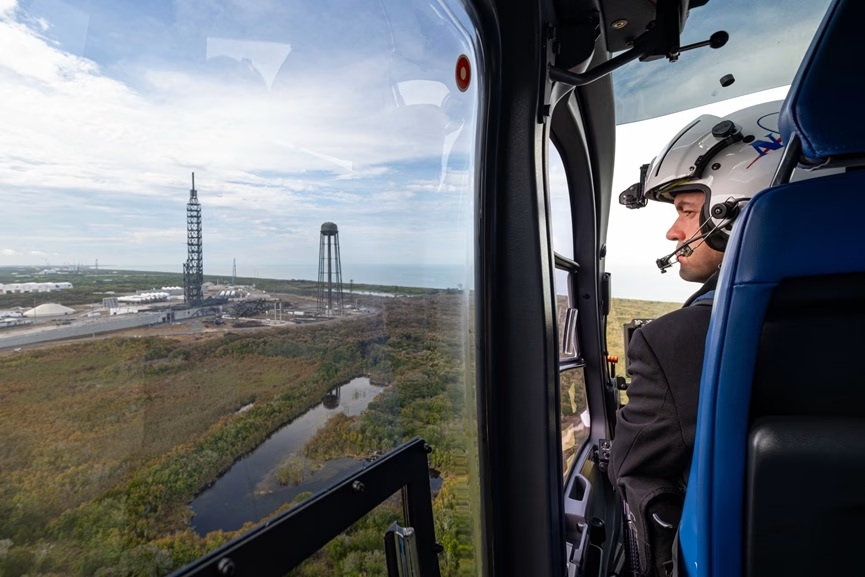
US: Blue Origin is facing one of the biggest setbacks in its history after an explosion during a pre-launch engine test severely damaged a launch pad used for its New Glenn rocket, raising concerns about delays to future missions, Amazon’s satellite network plans, and key NASA lunar projects.
The incident occurred during a routine test firing ahead of a planned New Glenn launch scheduled for next week. According to industry sources, the booster involved in the test was named “o, It’s Necessary,” a reference to a line from the science-fiction film Interstellar.
Early assessments suggest the damage is extensive. Sources familiar with the situation indicated that the launch facility suffered significant destruction, with repair work expected to take several months.
The disruption comes at a crucial stage for Blue Origin as the company works to establish New Glenn as a major competitor in the commercial launch market.
The setback could have wider implications for Amazon’s Project Kuiper, the company’s satellite broadband initiative designed to compete with SpaceX’s Starlink network.
Amazon plans to deploy more than 3,200 satellites in low-Earth orbit and must place half of them into service by July 2026 to meet regulatory deadlines.
Any prolonged suspension of New Glenn operations could place additional pressure on Amazon’s deployment schedule. Although the company has secured launch agreements with multiple providers, New Glenn was expected to play a central role in carrying large batches of Kuiper satellites into orbit.
Industry analysts note that shifting more missions to alternative rockets may prove challenging. While SpaceX’s Falcon 9 remains available, it can carry fewer Kuiper satellites per launch than New Glenn, meaning Amazon would need a greater number of flights to maintain its rollout plans.
Thank you for being here today. Your support means a lot to the whole team. We will get back to flight, and we will get to the Moon. Gradatim Ferociter. https://t.co/BBG5IgoWRY
— Jeff Bezos (@JeffBezos) May 30, 2026
The explosion has also strengthened SpaceX’s position in the commercial launch sector. SpaceX founder Elon Musk publicly expressed support for Blue Origin following the incident, posting a message wishing the company a swift recovery.
Beyond commercial operations, the damage has raised questions about future NASA missions. The affected rocket was expected to launch Blue Origin’s first Blue Moon lunar lander later this year.
The company recently secured a NASA contract to deliver two lunar rovers in support of future Artemis missions.
NASA said that it is evaluating the potential impact on upcoming lunar exploration programs. Meanwhile, the US Space Force and the National Reconnaissance Office reaffirmed their commitment to Blue Origin’s recently awarded national security launch contracts.
Despite the setback, industry experts believe demand for multiple launch providers remains strong. While the accident may temporarily strengthen SpaceX’s competitive advantage, analysts say the long-term goal of creating a diverse and competitive launch market is unlikely to change.