
New Delhi: India is expanding its engagement with Latin America and the Caribbean as it seeks to strengthen economic partnerships, diversify access to strategic resources and deepen cooperation with countries of the Global South.
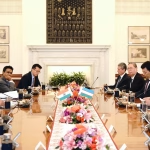
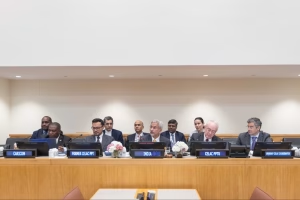
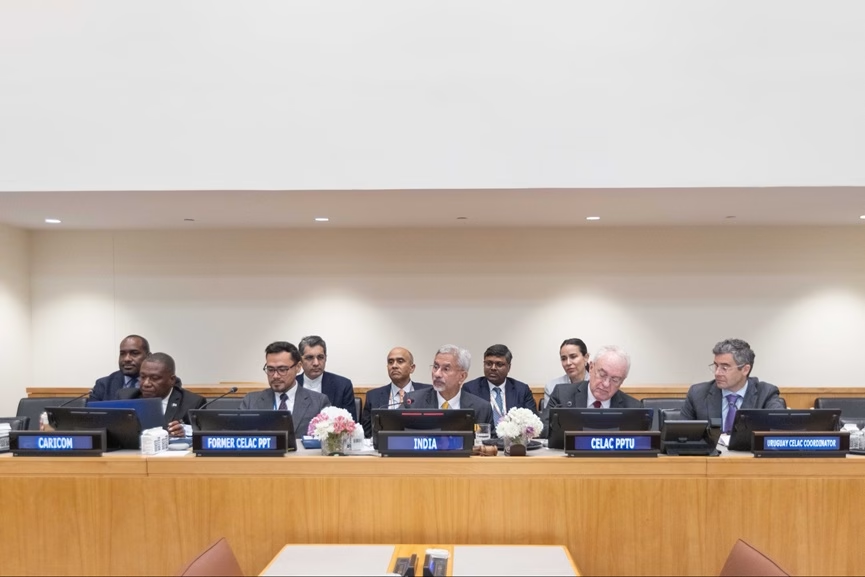
The shift was highlighted at the India-CELAC Expanded Troika Foreign Ministers’ Meeting held in New York, where 30 of the 33 members of the Community of Latin American and Caribbean States (CELAC) participated.
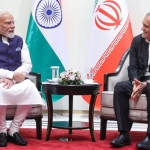
External Affairs Minister S Jaishankar co-chaired the meeting with Uruguay Foreign Minister Mario Lubetkin, while Saint Lucia Foreign Minister Alva Baptiste also participated in the Troika discussions, according to India’s Ministry of External Affairs.
The meeting covered trade, health and pharmaceuticals, food and agriculture, energy and resources, small and medium-sized enterprises, digital cooperation and capacity building.
Participants also discussed expanding Indian Technical and Economic Cooperation (ITEC) slots for CELAC countries and supporting Indian-led initiatives including the International Solar Alliance, Coalition for Disaster Resilient Infrastructure, International Big Cat Alliance, Global Biofuels Alliance and Mission LiFE.
The two sides also agreed on an annual India-CELAC ministerial meeting and discussed establishing a permanent commission and a cooperation roadmap.
Trade and economic cooperation
India-CELAC bilateral trade reached $50 billion in 2025-26, according to the Ministry, marking a significant expansion in economic ties.
India’s engagement with Latin America has traditionally included pharmaceuticals, automobiles, machinery, information technology, chemicals and agricultural commodities. Indian companies have also explored opportunities in energy and mineral resources.
The relationship is now broadening toward manufacturing, digital services, technology, renewable energy, logistics and infrastructure.
Co-chaired the India-CELAC Foreign Ministers’ Meeting today along with FM Mario Lubetkin @MinLubetkinUy of Uruguay. #UNGA81. Thank the CELAC trio FM Alva Baptiste of Saint Lucia and FM @omarbula of Columbia for joining.
Attended by 30 CELAC members, the largest ever, CELAC… pic.twitter.com/z5BYdgbeO2
— Dr. S. Jaishankar (@DrSJaishankar) September 22, 2026
Critical minerals and energy
Critical minerals emerged as a key area of cooperation as India seeks to strengthen supply chains needed for clean-energy technologies, advanced manufacturing and other strategic sectors.
Latin America and the Caribbean have significant resources of lithium, copper, silver and graphite, along with reserves and production of several other minerals relevant to the global energy transition.
India’s National Critical Mineral Mission is focused on strengthening the country’s critical-mineral value chains, including exploration, mining, processing and overseas acquisition of mineral assets.
Energy is another potential area for closer cooperation. Latin American countries have significant oil, gas and renewable-energy resources, while India is seeking to diversify its energy sources and strengthen cooperation in areas such as solar power, biofuels, green hydrogen and battery technologies.
Agriculture and food security
Agriculture also offers scope for expanded cooperation. Latin America is a major agricultural producer and exporter, while India has capabilities in agricultural technology, irrigation, pharmaceuticals, food processing and agricultural research.
The partnership could therefore extend beyond commodity trade to food processing, climate-resilient agriculture, irrigation, seed technology and research.
Digital cooperation and disaster response
Digital transformation was another focus of the discussions. India’s experience with digital public infrastructure, including digital identity, payments and technology-enabled public services, could provide areas for cooperation with developing economies in the region.
The Ministry said CELAC members also appreciated India’s humanitarian response to Jamaica, Venezuela and Colombia following earthquakes in 2025 and 2026.
Both sides identified disaster management and humanitarian assistance as areas for continued cooperation, alongside climate action, renewable energy, health, food security, infrastructure, space cooperation and capacity building.
The discussions also included efforts to strengthen political dialogue, economic cooperation and people-to-people exchanges, with both sides agreeing to work toward an institutional mechanism for periodic review of their engagement.