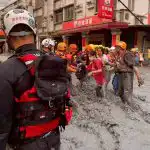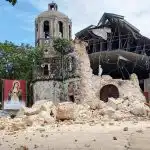

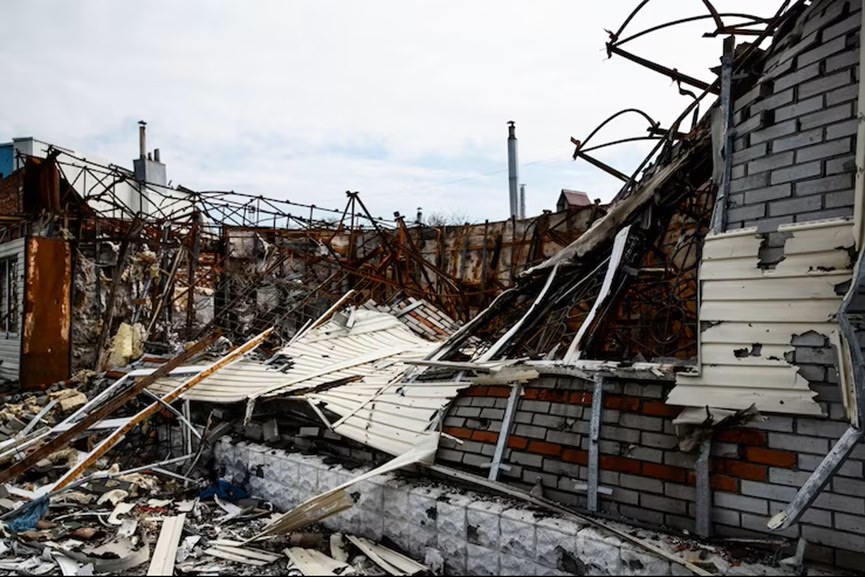
Kumamoto, Japan: The death toll from the powerful earthquake that struck southwestern Japan has climbed to 34, as rescue teams continue searching through collapsed buildings and damaged industrial sites in Kumamoto Prefecture.
The magnitude-7.1 earthquake hit Japan’s southern island of Kyushu on Tuesday, causing widespread destruction, cutting electricity to thousands of homes, disrupting transport services, and forcing thousands of residents to seek shelter.
Kumamoto prefectural authorities said that on Friday that 34 deaths have now been confirmed, while another death remains under investigation. Dozens of people were injured, including several who remain in serious condition.
Some of the deadliest incidents occurred at two separate locations. At an Aeon Mall in the town of Kashima, shoppers were evacuated after the quake before an explosion rocked another section of the building.
Part of the second floor collapsed, trapping people inside. Officials said seven people died at the site, while rescue workers managed to pull 11 survivors from the rubble. The number of people still missing has not been disclosed.
Another major tragedy unfolded at a Nippon Paper Industries factory in Yatsushiro, where a chimney collapsed during the earthquake. Rescue operations at the site have ended after workers recovered nine bodies and rescued 11 people.
本日13時30分から、「令和8年熊本地震第3回非常災害対策本部会議」を開催しました。
今回の地震でお亡くなりになられた方に、哀悼の誠を捧げるとともに、謹んで御遺族の皆様にお悔やみを申し上げます。…
— 高市早苗 (@takaichi_sanae) July 30, 2026
The earthquake also knocked out power to tens of thousands of homes. While electricity has gradually been restored, more than 3,500 households were still without power on Friday, according to Kyushu Electric Power Co.
Over 9,000 people remain in evacuation centers. Emergency teams are installing additional power supplies to run air conditioners as the region faces intense summer heat, with temperatures expected to reach 36 degrees Celsius.
Prime Minister Sanae Takaichi urged residents to stay alert, warning that strong aftershocks remain possible. Officials are also monitoring growing concerns over dehydration and heat-related illnesses among evacuees.
Japan sits on one of the world’s most active seismic zones and experiences frequent earthquakes. Kumamoto was also the scene of a devastating earthquake in 2016 that claimed 275 lives, making the latest disaster a painful reminder of the region’s vulnerability.